
Having now completed forty-six circumambulations around the sun, perhaps it is time for a little reflection.
Is there a connection between a spicy street food item known as the phuchka and financial management, a critical but bland and dry aspect of our lives?
For the uninitiated, let me hasten to add that the term phuchka refers to those mouth-watering tiny hollow spheres of wheat flour or semolina, duly stuffed with spicy fillings of mashed potato, chickpeas, and finely chopped onions, served with tangy water flavoured with many kinds of additives, the two most popular ones being mint/coriander and tamarind. Yes, you could also know of it being referred to as puchka, golgappa, pani puri, gup chup, or pani ke batashe, depending on which area of India you happen to be in.
This reflection of mine is not about the financial aspect of either production or marketing of the humble phuchka. Nor is it about the seething frustration and helplessness that our tax sleuths experience owing to their inability to bring the street-cart owners merrily peddling their delectable stuff within the ambit of our tax laws. A vast majority of such vendors do not appear on their radar, simply because they do not file income tax returns. If our financial mandarins ever decide to bring the serving of phuchkas under the notoriously complex Goods and Services Tax instead, all hell may break loose. Housewives of all hues, sizes, and shapes will surely register a protest by refusing to cook at home, unless they too get compensated for rendering homemaking services.
Uncle Tom, had he been around, would have loved to suggest to Aunt Dahlia to shut down the publication of Milady’s Boudoir. He would have persuaded her to instead get into the highly profitable activity of selling phuchkas and save taxes for the family.
Rather, this rumination of mine is essentially about the financial gains made by me when I was a hormone-rich youth and had the wisdom not to deploy the phuchka as one of the tools in my arsenal to woo prospective girlfriends. Whether that ‘wisdom’ (if that is the term I want) ultimately improved my finances is another matter, to which I shall soon return.
The India of My Youth
I cannot speak for the members of the tribe of the delicately nurtured, but as a male child growing up in an average middle-class family in Bengal, I was initiated fairly early into a particular skill which, I suspect, was taught with remarkable consistency to a great many Indian boys of my generation, though never, so far as I remember, appearing on any school syllabus.
The ideal was something approaching the old English butler: whatever volcanic disturbances might be taking place within the soul, outwardly one was expected to preserve what those books, in their gloriously dated way, might call ‘the easy insouciance of a Red Indian at the stake’.
The finished product of this training was generally described, with considerable approval, as a man with nerves of steel.
Anyone brought up in a similar atmosphere will appreciate that the “English-butler” condition cannot be acquired in a single sitting.
It requires practice.
A great deal of it.
It therefore occurred to me fairly early that falling in love might impose an unreasonable additional workload upon an already overburdened emotional-control department.
Love, from what I could gather, involved uncertainty.
There could be misunderstandings.
There could be decoys.
There could be rejection.
There could even be acceptance, which, on closer inspection, seemed to create an entirely new category of problems.
And then there were parents.
One must remember that, in the India of my adolescence, being caught in a romantic relationship could acquire approximately the social atmosphere of being caught attempting to tunnel out of prison.
The unfortunate captive was only the beginning.
The family became involved.
Relatives became concerned.
Neighbours who had shown no interest in one’s welfare for eleven years suddenly developed intelligence-gathering capabilities that would have made the detectives at Scotland Yard sit up and take notice. Privacy, in such circumstances, existed chiefly as a philosophical concept.
I could quite imagine my father opening the morning paper and finding this headline staring him in the face.
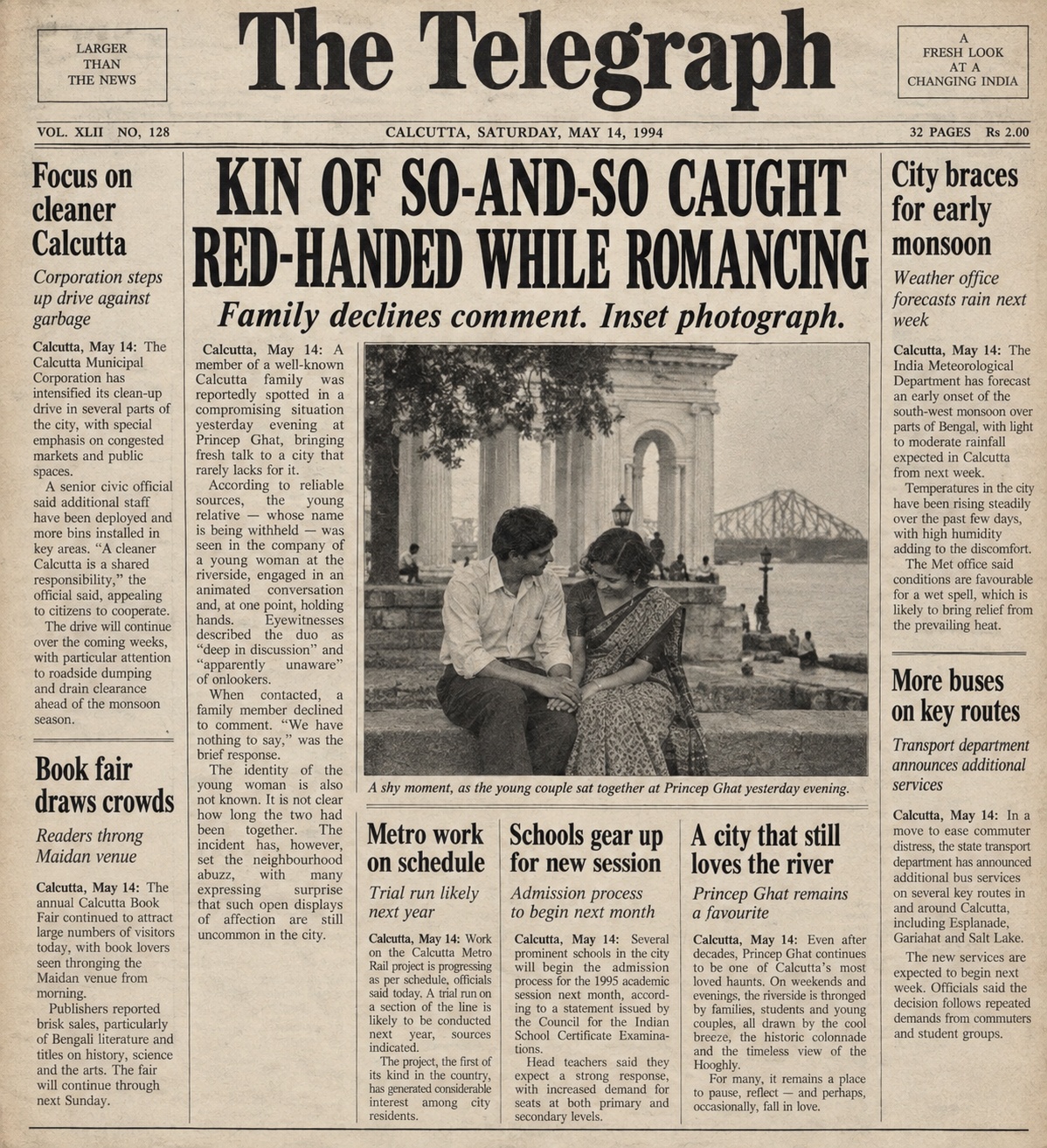
This, I felt, was publicity of entirely the wrong sort.
In any case, I had no ambition to follow Bingo Little in flitting from one romantic enthusiasm to the next in his pre-matrimonial phase of life. A young man intent upon his education had quite enough on his plate, leaving him little time for concerts, museums, Spinoza and the Bhagavad Gita, let alone for escorting a lady through a crowded Chowringhee (or any part of Kolkata) by-lane where the phuchka sellers lay in wait. A visit to a movie hall once a quarter, and that too in parental company, was considered luxury enough to keep frivolity within “acceptable limits” — limits which, my wife now assures me, already bordered on parental extravagance.
The perks and the perils of feasting on phuchkas
I confess that, in principle, I have nothing against the humble phuchka. It provides carbohydrates, protein and fat-soluble vitamins – a combination that would leave even someone fussy like Laura Pyke nodding in approval. Moreover, it also provides a vigorous practical course for the immune system, being frequently accompanied by water whose parentage does not always encourage detailed inquiry.
The more serious difficulty, I understand, is stopping once proceedings have begun.
Phuchka, however, is more than food. I strongly suspect that its stalls are among the great unofficial witnesses to romantic history in Kolkata and elsewhere. Registrars record marriages. Courts record divorces. But it is the phuchka stall owner who knows what happened in between. Had he kept minutes, several histories of Indian courtship might by now have been considerably better documented.
Economically too, it is admirably suited to the purpose. For generations of young couples, it has offered a remarkably attractive romance-to-capital-expenditure ratio. One could meet, talk, eat and return home without requiring institutional finance.
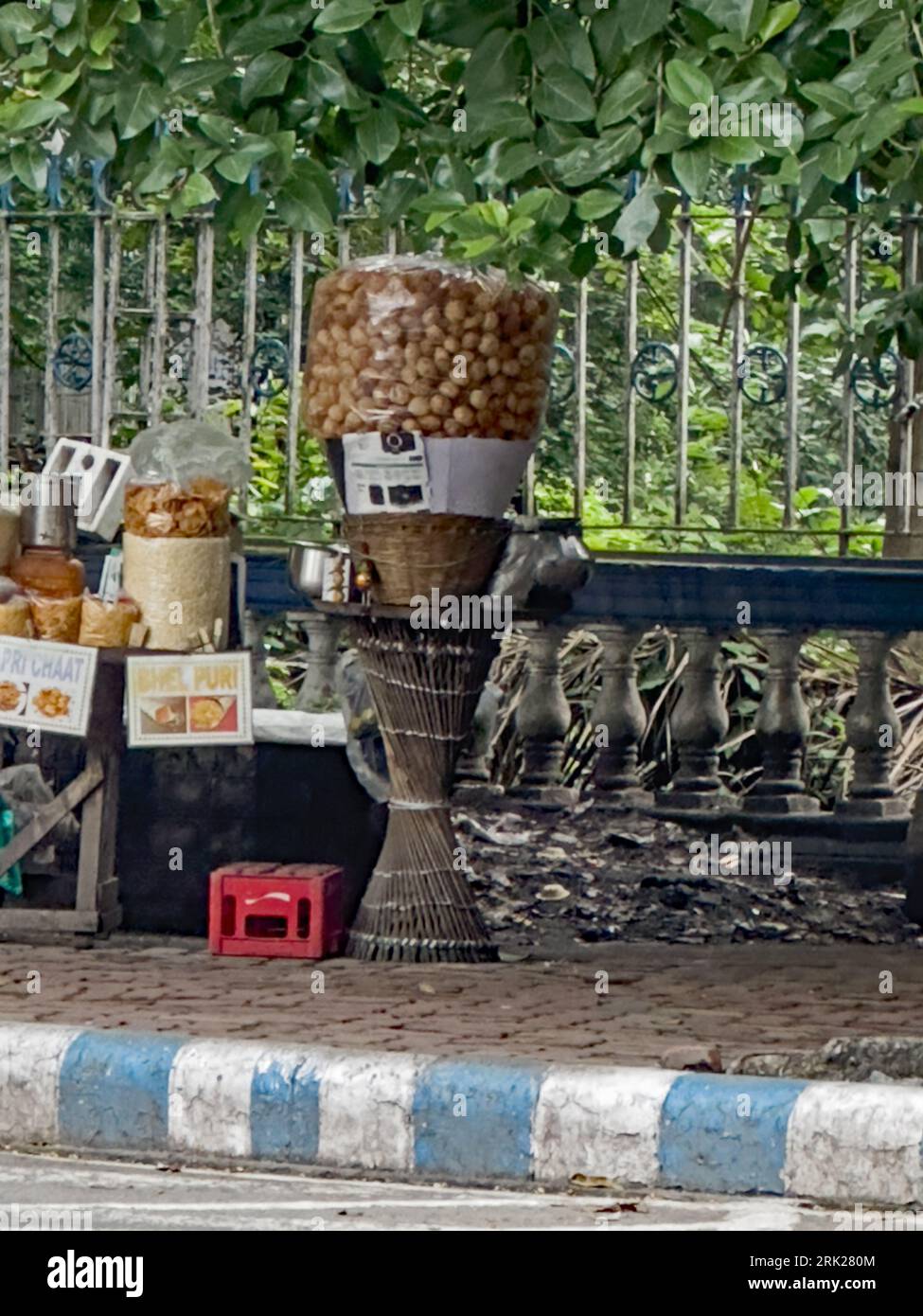
I have sometimes thought that phuchka possesses certain further advantages which the romantically inclined might appreciate better than I do. A man may also gaze into his lady love’s eyes with the sort of attention Wordsworth reserved for daffodils, while being recalled now and then to earthly affairs by tamarind, chilli and spice upon the tongue. Even Wordsworth, I suspect, might have relished the interruption.
And if the lady prefers the next round hotter, the gentleman may request an additional touch of chilli with something of the old knightly spirit. The treasure is modest, and the journey to the seller does not normally involve dragons, but these are details. To a man in love, I imagine, gallantry has always been less a matter of distance travelled than of the lady being pleased at the end of it.
However, my Guardian Angel had thoughtfully provided me with my own defences. I have always had an apprehension about tangy things, and the tamarind water formed the first barrier.
I have often observed what happens to others when the aroma from a phuchka stall invades their olfactory nerves. Their eyes bulge. Their mouths water. Some primitive mechanism appears to seize executive control of the nervous system and redirect the entire person towards the source.
Nothing similar occurs in my case.
My nervous system receives the information and merely files it.
As I grew older, hygiene joined the prosecution, though by then the case hardly required further evidence.
I have therefore been forced to accept that I may be one of the very few Bengalis entirely untouched by the emotional power exerted upon Homo sapiens by the humble phuchka.
Indeed:
I am as ignorant of this dish as an elephant is of modest self-presentation.
The economics of not having splurged on phuchkas
I therefore chose what appeared to be the safer road and, in my hormone-rich years, diligently avoided spending money on phuchkas.
Robert Frost had his Road Not Taken.
I had mine too, though mine contained fewer yellow woods and rather more parental surveillance.
Looking back from forty-six, I have discovered something which Frost, so far as I know, neglected to mention.
There was money in it.
And this brings us, inevitably, to the accounts.
A self-audit would plainly lack the necessary objectivity which an independent auditor may bring to the table. I therefore placed the matter before McCay of the Cape Pleasant Club, a chartered accountant whose professional qualifications were, fortunately for the case in hand, accompanied by a distinctly romantic temperament.
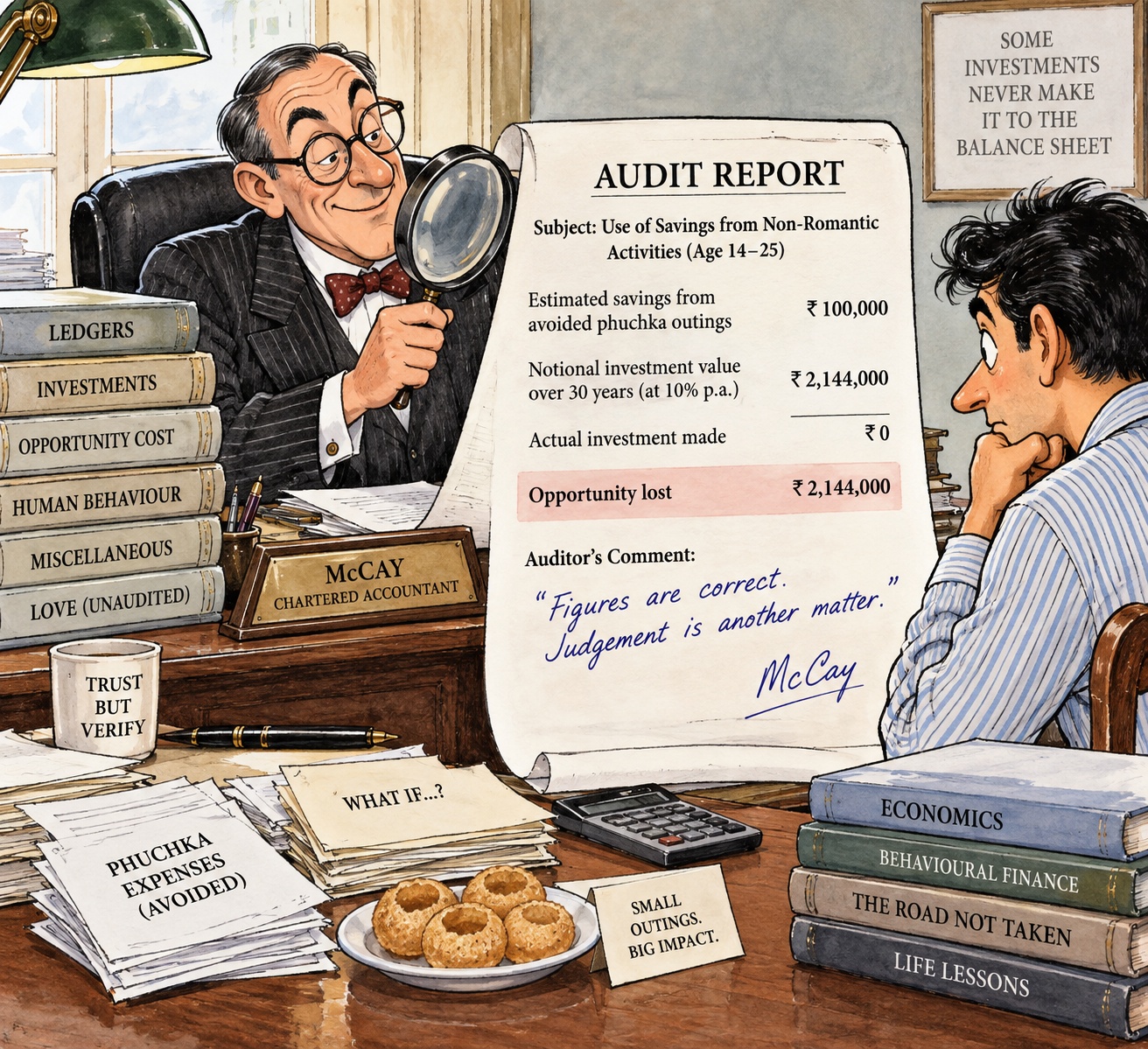
Independent Auditor’s Report on Romantic Phuchka Escapades
Period under Review: Age 14 to Age 46
We have examined the financial consequences of the Subject’s youthful decision not to employ phuchka as an instrument of courtship.
The accounts disclose the following:
Potential romantic engagements avoided: 1,664
Estimated plates thereby not consumed: 3,328
Average value adopted per plate: ₹30
Total expenditure avoided: ₹99,840
Rounded in accordance with Generally Accepted Principles of Convenient Arithmetic:
₹100,000
The auditors note that this result was achieved without budgeting, investment planning or any recognisable financial discipline.
The principal method appears to have been: Nothing happened.
Supporting Evidence
Management was asked to produce girlfriend records, love letters, dating histories, joint photographs or credible third-party evidence of phuchka-induced courtship.
None was produced.
Ordinarily this would constitute a limitation of scope.
In the present case, it was considered unusually persuasive evidence.
Phuchka-Linked Romantic Asset: Not Identified.
Items Not Provided For
The above figure relates to phuchka alone and makes no allowance for:
- The unexpected second plate,
- Subsequent gobbling up of aloo tikki, dahi-puri and allied chaat items,
- Tea on account of rain,
- Transport,
- Birthday and anniversary provisions,
- Gifts purchased after being specifically informed that no gift was required,
or that highly volatile instrument: “I don’t want anything.”
Nominal value: ₹0
Actual exposure: Unknown
Risk classification: Emotionally Leveraged
Parental intervention, neighbourhood surveillance and emergency family consultation have likewise not been valued.
Auditor’s Opinion
The Subject’s performance in phuchka-linked courtship has been poor.
His cost control has been admirable, though he scores poorly in terms of Return on Love.
Return on Love: 0%
Return on Not Falling in Love: approximately ₹100,000
Few enterprises, in the auditors’ experience, have achieved thirty-two years of exemplary restraint with so little active management.
Signed,
McCay
Chartered Accountant and Secretary, Cape Pleasant Club
Department of Unrequited Accounts
I therefore closed the accounts with something of the serenity which, perhaps, descended upon the Buddha beneath the Bodhi tree. However, the outcome in my case was, admittedly, of a rather more mundane order. Stilton Cheesewright, who had once temporarily come under the influence of Buddhism, would have heartily approved of my sentiments.
There it was in black and white: my early decision to steer clear of romantic entanglements had apparently produced a surplus of approximately ₹100,000.
Not bad.
Then, unfortunately, I made the mistake of thinking further.
What if the money had been invested?
My first calculation, attempted with roughly the degree of financial sophistication that has characterised several of my actual investments, was tremendously encouraging.
₹100,000 compounded at around ten per cent annually for thirty-two years could, under sufficiently friendly assumptions, become roughly:
₹2.1 million!
This was no longer phuchka money.
This was a financial philosophy.
For one brief, intoxicating moment, what I had mistaken for romantic underachievement began to resemble an investment strategy of extraordinary crudity.
A stark realisation dawned. The savings had accumulated gradually. The full amount was not sitting obediently in my pocket on my fourteenth birthday awaiting deployment into a diversified portfolio.
The ₹2.1 million was therefore what accountants might call an aggressively optimistic scenario.
A modest monthly investment scheme, begun early and regularly fed with the expenditure avoided, might nevertheless have done the trick.
And this, I confess, annoyed me more than the absence of romance.
Over the years I had apparently exercised admirable control over oxytocin and absolutely none over asset allocation.
Nobody had mentioned that avoiding expenditure was only half the job.
One was expected to invest the blasted thing afterwards.
There is perhaps a little philosophy buried here after all, though I have serious doubts if someone of the calibre of Stanley Featherstonehaugh Ukridge would have approved of it. I suspect he might instead have established a Lovers’ Opportunistic Fund, into which people like me would have poured their phuchka savings, only to discover that he had decamped with the corpus and started a chicken farm in Switzerland.
We spend a surprising amount of life congratulating ourselves for avoiding one danger, only to discover that safety itself came with instructions nobody informed us about.
I took the safer road.
And, with admirable consistency, failed to invest the proceeds.
Thus, at forty-six, I carry one additional piece of wisdom.
Somewhere along the journey, I may have misplaced a perfectly respectable investment portfolio.
It appears, after all, that controlling oxytocin was the easy part.
Controlling capital required a maturity for which the auditors, even at forty-six, have found insufficient evidence.
What do you think, eh?
Related Posts





 ashokbhatia