Feeds:
Posts
Comments

Posts Tagged ‘Management’


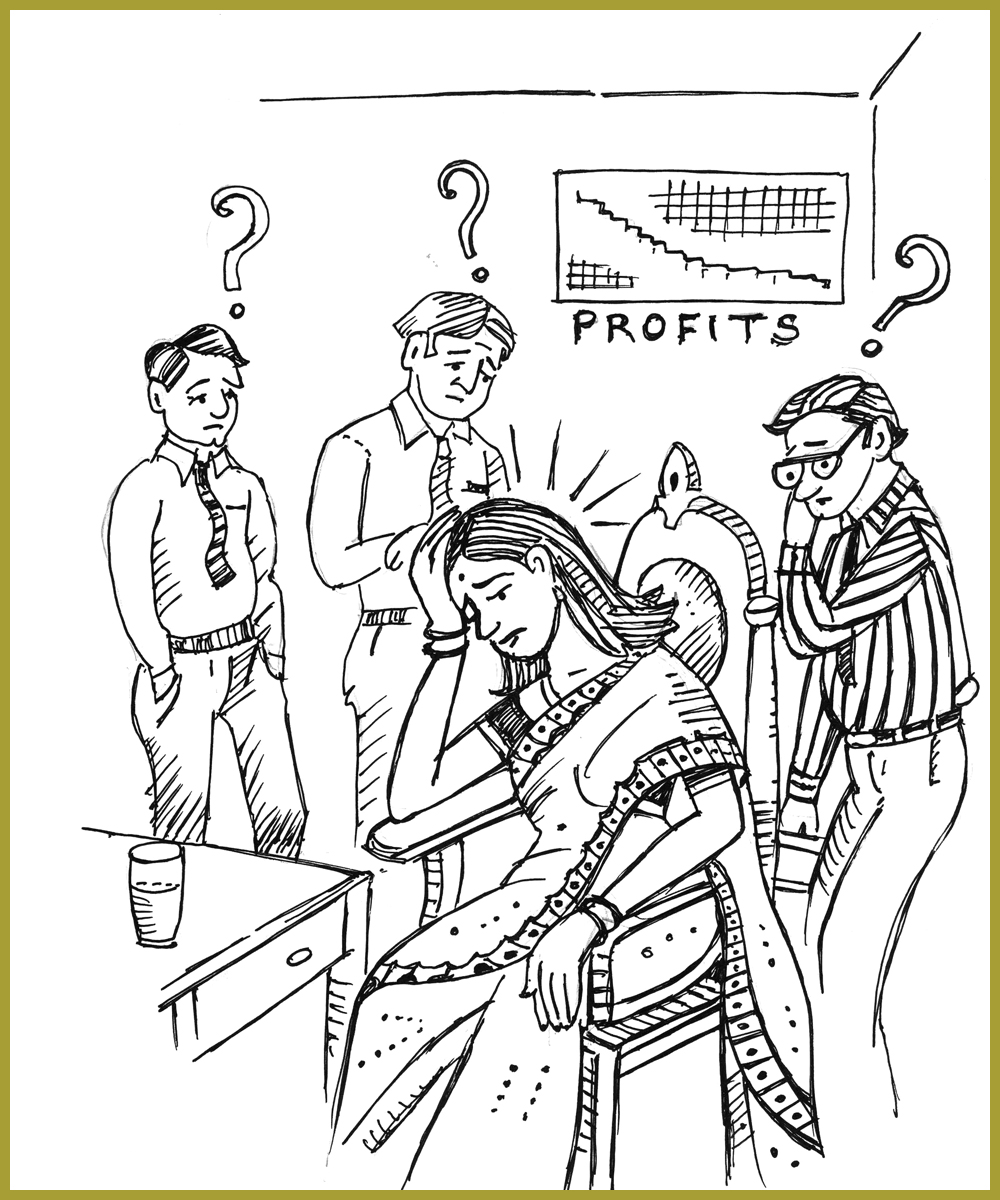
Many a times, CEOs and managers give in to a mood of despondency, much like Arjuna on the battle field of Mahabharata. It becomes a case wherein the person may approve of the broad general principle of a strategy to be followed or a target to be cracked, but cannot help but shudder inwardly at the prospect of putting it into effect.

Outside the window of the incumbent’s corner office, the sun may be shining. The sky may be an azure blue. A gentle breeze may be swaying the trees. Birds may be chirping. But Nature fails to provide solace. The mind is boggled. The heart is laden with woe. Confusion and self-doubt reign. A defeatist attitude prevails. Decisions taken in a mental state of this nature merely add to the chaos.

When the mind is boggled

CEOs would formulate a business strategy and even go into detailed planning of the steps involved with their team members. But when implementation starts, there is always a chance that they might develop cold feet. Practical considerations which were latent earlier suddenly pop up. Some initial steps reveal a chink in the organization’s armour. Or, some fresh feedback comes in, changing their perception of reality.

A new product launch could have been conceptualized and details worked out. Product attributes and design might have got frozen. R&D and Production might have burnt the proverbial night oil to come up with bulk samples which would have been successfully test marketed. Pricing might have been finalized. Packaging might have been given the go ahead. Members of the supply chain might have been brought on board.

However, when the launch day dawns, they might wake up all of a twitter, trying to imagine the reaction of a mightier competitor, or discover an environmental challenge or a customer health issue the product may pose, when pushed aggressively in the market.

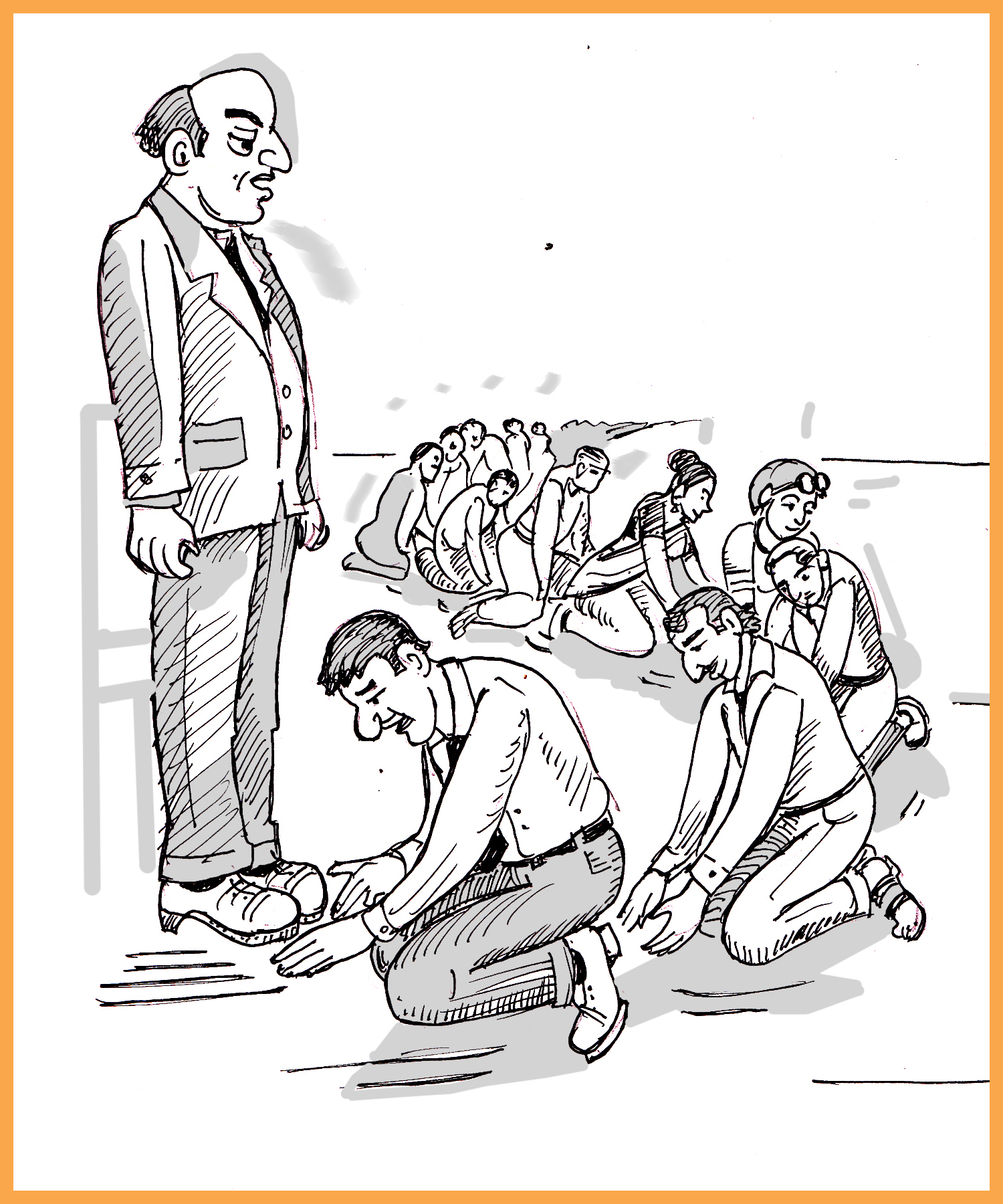
Likewise, when a big manufacturing unit has to be shut down in the overall interest of the business, the unit head may develop feet of clay, twiddling her thumbs about the future of the career of so many capable persons who would have to be called in, looked into the eye, and handed over a pink slip. Persons with whom there has been a long working relationship. Professionals who have been groomed by the unit head herself. Those who have been key members of the next rung of the organization’s hierarchy.  Employees who are elder in age and had assisted her in so many ways to settle down when she came into the organization and took over the reins of the unit. Those who have been loyal and had supported her through the slings and arrows of business faced by the unit.

Ramping down a business unit

Yours truly once faced a similar situation. A premium unit of a very large export house had become a liability in more ways than one. Over time, quality had suffered. Productivity was abysmally poor. Industrial relations had deteriorated. Every month, the headquarters had to be approached with a begging bowl, so wages and statutory dues could be paid off. Repeated attempts to revive the fortunes of the unit had failed. The mists of doubt had engulfed the befuddled mind.

Aided by a senior team member, a water tight case recommending immediate closure of the unit was prepared and presented to the management. A long phase of discussions, exchange of ideas and explanations ensued. Finally, clear thought and perseverance paid off. The painful decision to ramp down that part of the business was taken. Careful separation plans were worked out in advance. The pain of implementation followed. Some professionals had to suffer in the process. But in the overall interest of the organization, the task was carried out.

Of corporate dilemmas

The dilemma facing Arjuna on a battlefield some 3,500 years back was whether to go ahead with a war against his own cousins and senior family members.

Here are only two of the several cases which arose due to in-family disputes and misunderstandings.

Of Puma and Adidas

When brothers Adolf and Rudolf Dassler founded a shoe company in their mother’s laundry room in the town of Herzogenaurach, Germany, in 1924, little did they imagine that their relations would turn sour during World War II. A split followed in 1948, leading to the emergence of two brands – Puma and Adidas. The two still have rival factories on opposite sides of a river. Rudolf died in 1974 at age 76, Adolf in 1977 at 78. Never did they reconcile. Both are reportedly buried at opposite ends of the same cemetery.

The human pain behind Raymonds

Back in India, retired tycoon Vijaypat Singhania, entangled in a property dispute with his son Gautam Singhania, concluded thus: “Love your children and care for them, but don’t love them so much that you are blinded”.

Having made Raymond a household name across India, the father had handed over his shares, worth over Rs. 1,000 crore, to his son who now controls the Rs. 6,000-crore group. At the core of the dispute between the father and son were their rights over JK House, a family owned 36-storey redeveloped property in the posh Malabar Hill area of south Mumbai. The father was forced by the son to move to a rented accommodation, causing him discomfort and mental anguish.

If one considers the mental state of the businessmen who acted in the manner they did in a given situation, one’s mind invariably goes back to the kind of despondency and fatalism experienced by the great warrior Arjuna, upon surveying the armies facing each other. The army of Kauravas was not only numerically superior, but was also led by Bhishma, the grandsire. The futility of war which had cousins belonging to the same clan on either side left him twiddling his thumbs and wondering why to go ahead with the same, causing death and ruin all around.

Of Dualities, Dilemmas and Analysis Paralysis

CEOs of today face not only challenges of an economic nature, but also emotional upheavals caused by ethical and moral dilemmas involved in decision making. Regulators and NGOs keep snapping at their heels, while they are busy in a relentless pursuit of materialistic goals. There are indeed times when self-doubt plagues them. They feel as if they have reached the level of incompetence and can neither face a business battle, nor dare to tinker with the targets of economic expansion and business lust which normally pervade any business enterprise.

CEOs in the corporate world routinely face dilemmas which arise out of the dual nature of things. Almost all business situations are based on dualities. Often, these lead to the CEOs suffering from an Analysis Paralysis Syndrome.

Peter Drucker, the renowned management expert, frequently touched upon the dualities of freedom and power, authority and responsibility, progress and conservation, good and evil, worldly actions and spiritual fulfillment. He believed in the sanctity of spiritual creation. He considered traditional Christian values to be a type of practical wisdom and an ethical basis for responsible corporate leadership.

But Arjuna is smart. He is not only a proficient warrior prince, but also someone who has had the sterling sense of befriending a great friend, philosopher and guide in Lord Krishna. Gita is all about how Krishna pulls Arjuna out of this sense of despondency and motivates him to do his duty without attachment to the result thereof. Krishna has extraordinary skills in transforming the thinking of his disciple’s mind, gently steering it towards the task at hand.

The Bhagavad Gita for a befuddled mind

It is a human tendency to magnify one’s weaknesses and provide some extraneous reasons for justifying one’s state of inaction. Also, when one realizes the kind of sacrifices one has to make to achieve the goal one has set for oneself, doubts arise about the worth of the goal itself.

This is how Arjuna expresses himself at the beginning of the Great War, in Chapter 1:


वेपथुश्च शरीरे मे रोमहर्षश्च जायते || 29||
गाण्डीवं स्रंसते हस्तात्वक्चै व परिदह्यते |

My whole body shudders; my hair is standing on end. My bow, the Gandiv, is slipping from my hand, and my skin is burning all over. My mind is in quandary and whirling in confusion; I am unable to hold myself steady any longer. O Krishna, killer of the Keshi demon, I only see omens of misfortune. I do not foresee how any good can come from killing my own kinsmen in this battle.


न काङ्क्षे विजयं कृष्ण न च राज्यं सुखानि च |
किं नो राज्येन गोविन्द किं भोगैर्जीवितेन वा || 32||

O Krishna, I do not desire the victory, kingdom, or the happiness accruing it. Of what avail will be a kingdom, pleasures, or even life itself, when the very persons for whom we covet them, are standing before us for battle?


येषामर्थे काङ्क्षितं नो राज्यं भोगा: सुखानि च |
त इमेऽवस्थिता युद्धे प्राणांस्त्यक्त्वा धनानि च || 33||

They for whose sake we desire kingdom, enjoyment and pleasures stand here in battle, having renounced life and wealth.


Handling the lioness of a mighty challenge

When mighty challenges in one’s career menacingly stare at one, much like a lioness surprised when running into a hunter in the forest, one is apt to see no ray of light in one’s life. One feels as if one’s Guardian Angels have gone off on a long vacation, that too without seeking any prior consent, let alone permission.

At such times, when the fighting option has simply evaporated, Bhagawad Gita gives one a chance to introspect and make an objective assessment of the situation at hand. In the midst of an overwhelming situation, reason returns to its throne. Trees and bushes nearby, which are just a step away and offer a possibility of the flight option getting exercised, get evaluated. The time it would take to load the rifle and shoot the lioness gets assessed. One even weighs the option of smiling and looking into the eyes of the animal, thereby hoping to settle down in a spirit of peaceful coexistence. One thinks of nibbling at some juicy lamb sandwiches after having first shared some with the cub lurking around nearby. Sure enough, a gesture of this kind is apt to make the lioness take a less jaundiced view of the proceedings, enabling the hunter to emerge unscathed from the encounter.

When one has sunk to the bottom of an emotional pit, and the horizon looks bereft of any hope, one can safely find solace, inspiration and guidance in the Bhagavad Gita. It speaks in detail about such concepts as detachment, equanimity and the need to uphold righteousness under all circumstances. It describes in detail the kind of practical steps one can take to handle the harsh slings and arrows of one’s life and career.


(Illustration on top has been drawn by Mr Upendra Ratra, an artist. The illustration depicting Krishna and Arjuna in the battlefield has been reproduced with permission from the illustrator, Arati Shedde, and Heartfulness Magazine – www.heartfulnessmagazine.com.)


Read Full Post »


Here are some more gems of wisdom from the book:

  1. I am what I am.
  2. Samuel Johnson: There lurks, perhaps, in every human heart a desire of distinction, which inclines every man, first to hope, and then to believe, that Nature has given him something peculiar to himself.
  3. ‘I Am Something’ mindset believes that I am neither above you, nor below you. I am neither in front of you, nor behind you. I am neither away from you, nor near to you. I am along with you. I am however different and distinct. So are you.
  4. Mukesh Ambani, Indian industrialist: In the journey of an entrepreneur, the most important thing is self belief and the ability to convert that belief into reality.
  5. Maxwell Maltz: Low esteem is like driving through life with your hand brake on.
  6. The significance of being insignificant.
  7. Ravi Thilagan, Management Educator: ‘I Am Something’ is assertion. ‘I Am Everything’ is aggression and ‘I Am Nothing’ leads to submission. ‘I Am Something’ perhaps leads to courage and humility in right proportion?

(Yours truly has contributed some of the chapters in the book and has also edited it.)

(Related Post: https://ashokbhatia.wordpress.com/2019/03/11/some-quotable-quotes-which-appear-in-the-book-on-leader-mindsets)

Read Full Post »


  1. Dr S Radhakrishnan, former President of India: Man is the cause of the problem, as also its solution.
  1. Sri Aurobindo, the great thinker: Mastery means the knowledge of handling certain vibrations; if you know how to handle these vibrations you have the mastery. 
  1. Jean-Paul Sartre: Everything has been figured, except how to live. 
  1. Confucius: It’s better to light a small candle than to curse the darkness in our lives.
  1. Ekanath Easwaran: M K Gandhi’s faith in the power of the individual formed the foundation for his extremely compassionate view of the industrial era’s large scale problems as well as of the smaller but no less urgent troubles we find in our lives. One person can make a difference. 
  1. Atal Bihari Vajpayee, former Prime Minister of India: What matters is this/That there must be expanse with height /So that a man /Is not fixed and dead as a stump /But blends in and belongs with others. 
  1. Dr Ananda Reddy, Director, Sri Aurobindo Centre for Advanced Research, Pondicherry, India: The mindset of ‘I Am Something’ presents a judicial combination of management and philosophy.
  1. Marcel Proust (French Novelist, 1871- 1922): Love is space and time measured by the heart.

(Yours truly has contributed some of the chapters in the book and has also edited it.)

(Related Posts:

https://ashokbhatia.wordpress.com/2019/02/04/a-brand-new-way-of-increasing-leadership-effectiveness

https://ashokbhatia.wordpress.com/2019/02/10/a-word-about-the-book-on-leadership

https://ashokbhatia.wordpress.com/2019/02/19/key-takeaways-from-the-book-on-leader-mindsets

https://ashokbhatia.wordpress.com/2019/02/26/of-leadership-and-its-myriad-lenses)


Read Full Post »

The fascinating process we call Leadership can be viewed through several lenses. Each lens offers a unique perspective. Some are more comprehensive, others less so. But almost all reveal a facet which is distinctive in its own way.

Some of the lenses which management theorists and practitioners have used over the last 150 years to view the enigma called leadership are discussed in brief here.

The Trait Lens

The lens of the Trait Theories makes us notice the kind of personality traits of a leader which make him effective. Domain knowledge, self-confidence, interpersonal skills and charisma are some of the critical components here. However, these presume that the environment and the followers have no role to play when it comes to assessing the effectiveness of a leader. With such a uni-dimensional approach, where the personality traits of the leader alone count, it is neither practical nor desirable to compare this approach to that of the three mindsets under discussion here.

The Behavioural Lens

The lens of the Behavioural Theories of leadership leads us to such operating styles as dictatorial, autocratic, democratic, laissez-faire, and the like. In the spectrum of direct authority exercised, if the dictatorial style implies maximum control, the laissez-faire style would relate to minimum control, though not amounting to abdication.

The Contingency Lens

Yet another lens which we use to view the phenomenon of leadership is that of the Contingency Theories. These posit that the effectiveness of a leader is determined by the interplay of several factors – personality traits, behavioural patterns, nature of the task at hand, the composition of the group being led, and the kind of situation at hand.

An example is that of Fred Fiedler’s theory. It proposes that in extremely favourable or unfavourable situations, task-oriented leaders fare better, whereas in moderate situations, relationship-oriented leaders deliver better results. As a logical corollary, in a business situation which is changing rapidly, a new leader with a more appropriate operating style needs to be brought in.

The Situational Lens

The Hersey-Blanchard Situational Model is yet another lens with which one may view leadership. This one proposes that effective leadership rests on two fundamental concepts: Leadership Style and the group’s Performance Readiness level.

It follows that there is no single ‘best’ style of leadership. Effectiveness of a leader varies not only with the characteristics of the group being led; it also depends on the goal to be achieved.

The level of maturity of the followers determines the leadership style which would work the best. While dealing with new entrants to the organization, a leader would do well to follow a Directing Style. While dealing with seasoned professionals, a Delegation Style would yield better results. The other two styles envisaged are Coaching and Supporting.

The Transactional Lens

Then we have the lens of the Transactional Theories of viewing leadership. These are characterized by a transaction made between the leader and the followers. By implication, these place a higher premium on positive and mutually beneficial relationships between leaders and their respective followers. The effectiveness of leadership is thus believed to be dependent on the alignment between individual and organizational goals.

These theories propose that a system of reward and punishment alone works. A well-defined hierarchy, where everyone knows who the leader is and who is following, is a sine qua non. In a way, this is a premise which subjugates people, reducing them to mere cogs in the wheel, with no concern for social or human values. The adage ‘my way or the highway’ readily comes to one’s minds.

The Transformational Lens

The Transformational Theories provide yet another lens with which one may view leadership. Transformational leaders inspire their followers by their vision, by setting examples which are worthy of emulation, and by the sheer force of their own personality. In the process, they themselves develop as leaders. They are also able to groom leaders out of their more competent followers.

Four components of this model happen to be:

  1. Intellectual stimulation.
  2. Consideration for individual team members.
  3. Inspirational motivation.
  4. Idealized influence.

Transformational leadership theories work on the premise that people are motivated by the task that must be performed. This implies that the culture of the organization is such as to act as a key enabler for such leaders to be effective. There is an emphasis on cooperation, collective action and healthy competition. Tasks are designed to be challenging and desirous. The whole system is geared towards placing the community above individual egos.

The Lens of Three Mindsets

Yes-Men

Prof G P Rao, an eminent authority in the field of Organizational Behaviour, has recently proposed a new approach to viewing leadership.

This approach proposes three kinds of leadership mindsets: “I Am Everything’, ‘I Am Nothing’ and ‘I Am Something’. These are not mutually exclusive but co-exist, much like the three traits (Gunas) mentioned in Indian scriptures: Satvik, Rajasik and Tamasik. Time and business environment play key roles in determining the dominant mode of mindset a business leader has at a given point in time.

In a highly favourable business climate, a leader is apt to have an ‘I Am Everything’ mindset. In an unfavourable setting, a leader may end up having an ‘I Am Nothing’ mindset. In a moderate situation, an ‘I Am Something’ mindset is likely to prevail.

The approach is based on an empirical study and has been implemented in an IT organization in India. It has been discussed in detail in the book on Leader Mindsets.

The Composite Lens of Results, People and Ethics

This proposition is based on my own managerial experience of over four decades in the private sector. The basic premise here is that decisions are based not only on commercial considerations but also on sound ethics and values. Decisions which would serve the strategic interests of the organization and would never lead it to a situation of public disgrace and compromise.

If one were to take the liberty of modifying the Blake Mouton Grid, the leadership style of such a CEO would qualify for either a 9,9,9 or a 5,5,5 classification.

The modified grid leads us to 9 different styles which we have already discussed elsewhere in detail.

An Evolutionary Thought Process

Human thoughts forever keep evolving. Newer experiences come about. Refined paradigms surface. But each succeeding step is like a stepping stone. It is built upon the success achieved by, as well as upon the deficiencies noticed in, the previous ones. The different lenses of viewing leadership we have discussed here are no exception.

What we have attempted here is merely indicative and not exhaustive. Many more interpretations of leadership exist. Many more models and theories would emerge in the times to come. As businesses hurtle forward, armed with newer and smarter technologies, the need for humane leaders would only become more acute.

This would surely lead to newer lenses which would be more comprehensive and elaborate, and would better serve the needs of commercial enterprises better in future.

(A version of this article appears as one of the chapters of the book ‘I Am Something: Developing a New Leader Mindset’.)

(Related Post: https://ashokbhatia.wordpress.com/2015/12/24/looking-for-ceos-inspired-by-the-yuletide-spirit)

Read Full Post »

Our dream merchants keep dishing out movies. Some of us who use a managerial lens to view the same keep learning new lessons from these.

There are several parallels between a reel career and a real career. On the screen, we admire a hero. At our place of work, we admire some of our bosses. On the screen, we notice the oomph of a diva and fall in love with her, at least temporarily, till the time the next heart-throb pops up in another movie after some time. Likewise, in real life, we come under the temporary spell of a company. We join it, only to find that what was showcased as heaven turns out to be a hell in more ways than one. We then decide to shift our allegiance to another corporate we come across.

In the movies, we learn to hate a villain or a vamp. In real life, we run into those who oppose all our proposals tooth and nail. Some do it openly whereas others, much to our chagrin, do it covertly. We decide to move on to greener pastures, only to find some villainous characters there as well. Only the faces and names change, their jaundiced approach to us does not.

While watching a movie, we experience a willing suspension of disbelief. In real life, we often end up suspending our egos and our autonomy of thought. If a flick makes us travel to a fantasy land for 2-3 hours, a career makes us grind our heels for at least 10 hours a day.

Recently, an opportunity came up for yours truly to interact with members of the Ahmedabad Management Association in India. Some of the fresh ideas presented at the event could be summed up as follows.

Building Synergy and Team Management

  • Handling ethnic and regional prejudices
  • Seeking areas of agreement first
  • Building on strengths, Compensating for weaknesses; Synergy
  • Overcoming adversity
  • No eve teasing, No sexual harassment

Inspiring Leadership

The manner in which Nelson Mandela endeavours to overcome racial prejudices not only in his team of personal assistants but also in the country makes one sit back and wonder as to how he thought of using a sport like rugby to further his agenda. One of the qualities of leaders who inspire us is a capacity to indulge in out-of-box thinking to solve complex problems.

Brand Building


If one was about putting customer needs first, the other was about the use of even unethical means to achieve an ethical end – that of delivering better value to customers. Both cover a critical success factor which contributes towards building a brand.

Human Values: Energy and Wisdom

When a start-up driven by only youthful energy also starts tapping into the wisdom of an experienced executive, things start to fall into place. Business grows in a sustainable manner.

Firing and Terrorizing


The emotional cost of being on a firing spree could take its own toll, dulling sensibilities in a significant manner. The trauma of working under a tough and unreasonable boss leads to a deeper understanding of the managerial process.

Hormones vs Hierarchies


Managements can no longer afford to look the other way when their key performers happen to be having a serious affair with one of their team members. Work places need to be made more gender sensitive.

Battling the Cancer of Corruption


Both were a humorous take on the issue. One led to failure while the other one concluded on a positive note.

Aiming High


Demonstrates the kind of sacrifices one makes and the subterfuges one indulges in to climb the ladder to dizzying heights of one’s chosen profession. Managing successes and failures with a dash of equanimity is a critical factor.

Mentoring


Deep reserves of patience are a hallmark of a good mentor. The satisfaction of a job well done is far more important than the money at stake.

Start Ups


Identifying and tapping latent market potential is an important skill for an entrepreneur to have. Leveraging one’s core strengths happens to be another.


Some Observations of the Audience

  1. Quite a few movies gain traction due to the pre-release controversies which appear to get whipped up. Would you say that such controversies form a part of a well-orchestrated marketing campaign for the movie concerned?

In most of the cases, perhaps yes. When millions ride on a single movie, the producers would go to any lengths to keep the box office registers ringing aloud.

  1. Many of the movie reviews in the press appear to be unduly biased, either praising or panning a work in a superficial manner. Whom can we trust for an honest and objective review?

Good observation. Since I am active in blogosphere, over the years, I have somehow come to trust some individuals who, I believe, provide a balanced view of the movies which keep coming up. Here are some which might be of interest to those who love cinema:

Of course, there would be several others whom I am yet to discover.

  1. Why did you not think of becoming a movie critic yourself?

Simply because I would rather watch a movie with a quiet mind, sans a deadline and an editor breathing down my neck. Making one’s hobby a profession has its own perils! 

  1. The rising level of obscenity in our movies. Is there anything that can be done about it?

Trust our film makers to keep pushing the envelope further with each passing year. Shock, awe and titillation happen to be the name of the game. A rejection by audience could alone bring results. A self-certification by movie makers as to the Gender Sensitivity Rank of an offering could help.


(Notes:


Read Full Post »

The Spandan (Heartbeat) perspective


  • Innate divinity, intrinsic altruism and basic goodness of human beings are determinants of human existence and growth.
  • Spandan (Heartbeat, vibration, pulsation, echo) is the binding element of the entire universe and its living organisms.
  • A Maternalistic style of Management: The Mother as a symbol of – among others – (a)  Nurturing – caring, sharing and compassionate; (b) Faith in basic goodness of others; and (c) Empathy of the highest order.
  • Spandan approach, with emphasis on a high degree of sensitivity towards others’ needs (like a mother) as the quality of a leader.
  • Spandan Spectrum of Human Values 2013.
  • Spandan 3D Process of Diagnosis, Discovery and Development; Inculcation of Human Values in Organisations for sustained success.
  • Functionally Humane Leadership (FHL).
  • Functionally Humane Organisation (FHO).


‘I Am Something’ leader mindset

  • Leaders operate in three kinds of mindsets: ‘I Am Everything’; ‘I Am Nothing’; ‘I Am Something’.
  • ‘I Am Something’ believes that I am neither above you, nor below you. I am neither in front of you, nor behind you. I am neither away from you, nor near to you. I am along with you. I am however different and distinct. So are you.
  • Self is the pivot: For any meaningful change to take place, leaders themselves have to take the initiative.
  • The process of transformation involves three steps:  Remaking the Self to adopt the ‘I Am Something’ mindset; Facilitating others remake themselves along similar lines; Initiating a mindset change across an organisation.
  • An empirical study done by the author found that as many as 75.55% of those who participated were operating as per the ‘I Am Something’ mindset.
  • A practical roll out of the ‘I Am Something’ mindset is already underway at a company in India.
  • Globally, several businesses show a tendency to veer around the ‘I Am Something’ mindset. Some of the existing theories of leadership match the concept of this mindset.
  • Teachings of Gautama Buddha and Ramana Maharishi relate to the ‘I Am Something’ mindset.
  • With the onset of such technologies as AI, Robotics, Machine Learning, and the like, the importance of human values and ethics in management is bound to go up in the times to come. ‘I Am Something’ is a mindset concept of which the time has already arrived. Leaders of tomorrow need to hone their skills and attitudes in tandem with the impending changes.

Read Full Post »


You are a leader in any realm of human endeavour, whether managerial, social, political or cultural. You could be an entrepreneur, an institution builder, a Chief Executive Officer, a policy maker or a related functionary, either in the private sector, or in the public sector. You could be serving as a senior officer in a government department. You could even be heading the operations at a non-governmental organization.

You are perceived to be a successful leader. However, somewhere deep within, you carry within you a sense of creative dissatisfaction; a yearning to discover a practical way to transport yourself, your team and your organization into a happier and contented frame of mind. You are keen on going beyond your own professional and personal interests and in getting involved in humanizing your organization.

If so, this book could prove to be a game changer in more ways than one. It makes you see the world around you in a new light, without the filters of your preconceived notions. By making you aware of the kind of mindsets which affect your decision making, it offers a new lens with which you can view the phenomenon we call leadership.  The book then goes on to capture the results of an empirical study done by the author, thereby demonstrating the practical wisdom of what it proposes. Eventually, it offers you a practical guide as to how to go about implementing the changes you wish to make, so as to become a happier and a contented leader.

This book is not about a new leadership theory which might leave you fuming after discovering that it merely offers the proverbial old wine in a new bottle. It provides a fresh perspective on leadership. The perspective it presents has already been tried and tested in real time. Much along the lines of the famous Hawthorne studies of the 1920s, the approach to leadership is being rolled out in a corporate entity in India even as you go through the book in your hands.

The book also presents divergent perspectives on the subject of leadership from different subject experts, touching upon globalization and a bird’s eye view of different theories of leadership through the recent history of management thought. There is an attempt to understand leadership through the basic tenets of Buddhism. It also endeavours to connect the key teachings of Raman Maharishi to the realm of leadership.

The Soul of the Book and Some Crystal Gazing

The soul of the book, however, lies in its unique approach of SPANDAN, or human vibrations. Around the nucleus of this concept, it builds a mighty edifice of propositions which offer the potential of making you a more effective leader.

In the times to come, just how serious would be the threat to human supremacy from machines? In our age of Artificial Intelligence, Robotics, Machine Learning, Algorithm Analytics and Internet of Things, just how relevant would this new approach to leadership be?

The book proposes that in the impending man–machine conflict, human beings are not likely to suffer the same fate as that of the non-avian dinosaurs which went extinct some sixty-five million years ago. But the writing on the wall is clear. They need to roll up their sleeves and get down to the task of sharpening their soft skills. A humane approach to handling team members needs to be consciously developed.

Transforming Yourself and Others

To sum up, the book, through theoretical propositions and empirical evidence, presents a new way to look at the kind of a leader you could aspire to be, and the potential you have to grow further, making you a happier and contented person, exuding warmth and positivity to those whom you happen to lead.

It provides a fresh perspective which is not likely to lose its relevance in a future replete with technological advancements, environmental challenges and more potent uncertainties which leaders in any field of human endeavour would face in the decades to come.

Chapter-end Tasks on Introspection, Interaction and Initiation (3 Is)

To facilitate your learning process, the author has selected some themes and some quotes from mentors of repute. These are designed to enable you to Introspect at the individual level and also to Interact with others at a small group level. These could also motivate you to Initiate suitable steps at the collective/large group level, so members of your organisation could empower themselves and become more productive and responsible citizens over a period of time.

You will come across these suggestions at the end of some of the chapters. You can develop these themes further and convey the same to key individuals, small groups and large groups, in any form of communication – written, verbal, a group presentation and even a panel discussion. A final report based on collective feedback could assist you in measuring the effectiveness of this approach.


Read Full Post »


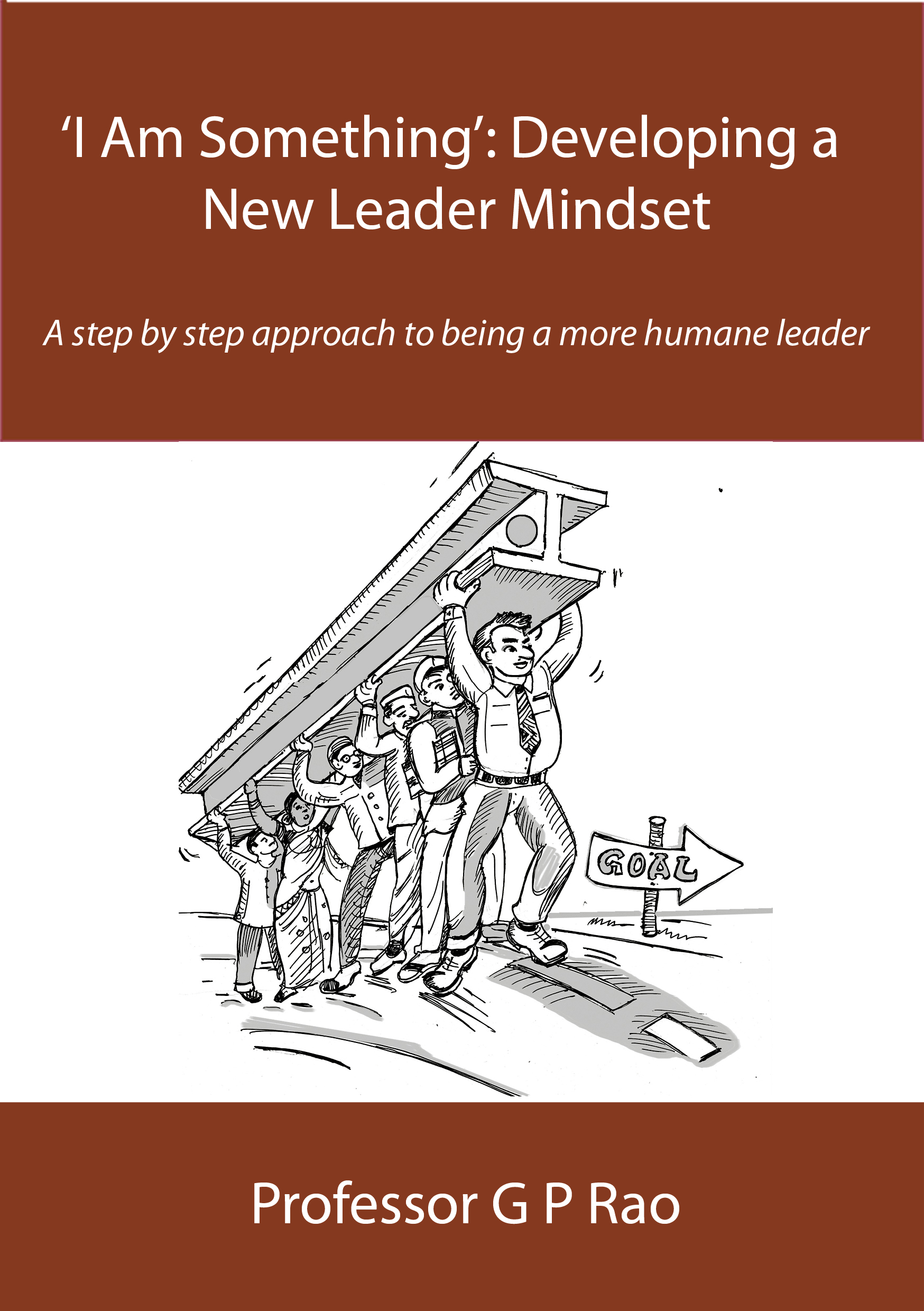
The importance of human values in our lives – whether personal or professional – can never be overestimated. In a book about to hit the market, the author, Professor G P Rao, builds upon his considered belief that managements which choose to ignore this crucial aspect in their decision-making do so at their own risk and peril. Their market valuations take a hit. Their brand image gets dented. They fail to take a long-term view of things. Instead, they end up window dressing the key performance parameters till the time the proverbial bubble bursts. They simply live from one quarter to the next, focusing on immediate deliverables.

In the upcoming book, the author not only proposes a theoretical construct of Leader Mindsets but also takes you through the steps involved in practising the same. Whether by way of an empirical study or by the means of a practical roll-out of the Spandan approach in an organization, results have been gratifying, establishing the value of the ‘I Am Something’ mindset towards the goals of organizations.

As humanity cruises along and takes off on the path of an exponential growth in technology, the need for a Spandan kind of approach would come into a sharper focus. Human values alone have the potential of acting as a rudder, keeping the trajectory of our evolutionary path on the right track. Leaders of tomorrow would find better satisfaction and happiness by adopting the ‘I Am Something’ mindset. So would their team members, were the leader to decide to facilitate their developing along similar lines. A spread across organizations and then across societies would be a logical corollary.

Read Full Post »

The relationship between Efforts and Results

One would have often wondered as to the nature of the relationship between efforts and results. A project on which much energy and time has been spent may get shot down by one of the seniors and never come to fruition. Another one, which has received only a fraction of the attention that was paid to the former one might take off and become a roaring success. Other than the effort, the timing plays a role in the success or failure of a project. Market conditions, government regulations, interpersonal relationships, employee engagement and several other factors also play a role.

A sense of detachment, as brought out by Bhagavad Gita, is not about one losing the sight of the objective sought to be achieved. Nor does it recommend a defeatist attitude in one’s life and career. Rather, it is about handling successes and failures in a balanced manner. Smart leaders, who have achieved a spectacular success, do not become complacent. They remain humble. They determine the critical success factors and store these at the back of their minds, ready to be recalled when necessary. When faced with dire failures, they shoulder the blame, get requisite feedback and take steps to ensure the failure gets avoided the next time round. If they lose interest for some time, they bounce back with renewed enthusiasm and work towards delivering results.

If one were to go through the history of the Apollo series of missions launched by the National Aeronautical Space Agency of USA during the 1960s and 1970s, one would be struck by the kind of tenacity and equipoise demonstrated by the participating astronauts. Despite losing several of their colleagues in accidents, they remained committed to the overall goal, delivering some spectacular results for our scientists and technocrats to work upon. The same trend continues till date. Airspace disasters notwithstanding, we keep sending missions to Mars and to Sun. The quest of humanity to explore our universe continues unabated.

Inner Resilience and Equanimity

A related feature is the need for professionals to improve upon their levels of Inner Resilience and practice Equanimity. This is what Bhagavad Gita says in this context.

योगस्थ: कुरु कर्माणि सङ्गं त्यक्त्वा धनञ्जय |
सिद्ध्यसिद्ध्यो: समो भूत्वा समत्वं योग उच्यते || 2.48||

Be steadfast in the performance of your duty, O Arjun, abandoning attachment to success and failure. Such equanimity is called Yoga.

Professionals need to know not only what is to be done, but also how it has to be done. Lord Krishna does not fail them. He recommends an ‘evenness of mind’, the tranquility of inner composure in handling all the pairs of opposites in their careers and lives – success and failure, praise and reprimand, hiring and firing, sprees of expansion and down-sizing, products and services which are at opposite ends of their life cycles, mergers and demergers, favourable and unfavourable circumstances, and the like. This, indeed, is held to be the real ‘Yoga’.

In the process, we need to give up our false expectations, wrong imaginations, daydreams about the fruits of our actions, anxieties for results, resistance to change, and fears about future events which are still in the womb of the universal force called Time.

The traits of a Super Leader

Hers is a balanced personality, free of unreasonable desires which pose the danger of her losing sight of her sense of righteousness. She does not have a binding attachment with her emotions. Nor does she have a jealous preference for her pet ideas or for her pet people. She scoffs at any signs of nepotism. She encourages her team members to be nay-sayers, so voices of dissent could be heard and judiciously dealt with. She radiates positivity all around her. She is committed to the organization’s goals and looks after her team members much like a lioness would protect her cubs.

Such a person of steady wisdom is described in Bhagavad Gita as a Stitha-Prajna. Consider the following:

दु:खेष्वनुद्विग्नमना: सुखेषु विगतस्पृह: |
वीतरागभयक्रोध: स्थितधीर्मुनिरुच्यते || 2.56||

One whose mind remains undisturbed amidst misery, who does not crave for pleasure, and who is free from attachment, fear, and anger, is called a sage of steady wisdom.

Two concerns may arise here. One, could there really be persons who could be held to have all these qualities? Two, is it really possible for one to be free of one’s basket of desires and one’s ego?

In his book ‘Beyond the Last Blue Mountain‘, R M Lala quotes the case of Jamsetji Tata, the founder of the Tata group of companies. It was he who gave the group a unique position in India. In his later years, he did not ask ‘What enterprise is the most profitable?’ but, ‘What does the nation need?’ Since the answer in his times was steel, hydro-electric power or an institute of science, he made his best efforts to fulfil that need.

He is reported to have once said something very basic:

We do not claim to be more unselfish, more generous or more philanthropic than other people. But we think we started on sound and straightforward business principles, considering the interests of the shareholders our own, and the health and welfare of the employees the sure foundation of our prosperity.’

Alfred Sloan is reported to have once remarked, ‘What is good for General Motors is good for America.’ J R D Tata always thought the other way round. ‘What is good for India is good for Tatas.’

Theirs is only one example of a business house which is clear in its goals and in its priorities. Several others could be quoted in the current context, like N R Narayana Murthy, the founder of Infosys.

Getting rid of desires and ego is no cakewalk. A CEO may introspect and fine tune her desires so the same are aligned with the values of the organization she works for. In the process, her personal desires take a back seat. Likewise, getting rid of one’s ego completely has a flip side. One could end up becoming a doormat and getting taken advantage of by all and sundry. Her wisdom and intuition can help her to retain her individuality even while letting go of the ego. Ask any CEO who has ever worked in a single-owner driven company, and she would attest to the basic principle of leaving the ego at the office gate itself!

Professionals who remain undistracted by transient entrapments have the ability to be rational and calm. They are steadfast in reaching their goals and go on to make successful business leaders.

Read Full Post »


On a lighter note, one needs to be wary of managements which exhort one to follow this much misunderstood principle of detachment expounded in the Bhagavad Gita. They would have one believe that one should continue to slog all year long but would do well not to expect that elusive overdue promotion. One can then either lump it and trudge along, or take prompt action through proper channels to get oneself detached from the company at the earliest possible opportunity!

An inspired self-forgetfulness

What is the secret behind mighty achievements? What is the state of mind in which an artist like Vincent van Gogh would have created his unique gifts to humanity? Could he have done so while being worried if his latest masterpiece would turn out to be better than the one he had made earlier? Could Michelangelo have sculpted Pieta with the sole purpose of receiving a reward or recognition for creating the same?

Was Newton worried about either his past or his future when the apple fell? Had that been so, is there not a chance that he might have missed out on discovering the forces of gravity? What are the conditions under which a product developer based in Silicon Valley comes up with her next bright idea? Which is the state of mind which is conducive to creative work?

Scratch beneath the surface of any work of inspiration and one is apt to discover the ultimate secret of great accomplishments. Living every moment of the present is one of the factors which help one to live an inspired life and also enjoy it to the hilt. The creative process is akin to meditation of sorts, where the creative person, the universe and the surroundings – all end up in a single harmonious state.

This is precisely what Bhagavad Gita means by detachment. It exhorts a CEO not to worry over and get herself preoccupied with the anxieties for the rewards of her actions, thereby avoiding a tendency to live in the future. Nor does it make sense for her to keep analyzing as to what transpired in the past and get overly worked up about it. The advice here is not to waste the present moment in inane memories and in concerns about the future. Rather, she can do her very best in the present moment, keep relevant stakeholders in the loop, and perform her duties, as dictated by a sense of virtuous righteousness. This way, she is released from all of her mental preoccupations. Work alone makes her live in the joy and ecstasy of inspired self-forgetfulness. The work itself becomes the reward.

कर्मण्येवाधिकारस्ते मा फलेषु कदाचन |
मा कर्मफलहेतुर्भूर्मा ते सङ्गोऽस्त्वकर्मणि || 2.47 ||

karmay-evādhikāras te mā phalehu kadāchana
mā karma-phala-hetur bhūr mā te sa
go ’stvakarmai

You have a right to perform your prescribed duties, but you are not entitled to the fruits of your actions. Never consider yourself to be the cause of the results of your activities, nor be attached to inaction.

Management by loftier objectives and Resistance to Change

Is it really possible for one to be detached with the fruits of one’s actions? In a business scenario, when a manager is part of an organization, she is expected to deliver results. Efforts put in by her do not count; results alone do. If so, one might well wonder as to how one can remain detached with the outcome. Would it not be going against the philosophy of Management by Objectives?

What one is being advised here is not to take actions which are at divergence with what is sought to be achieved. The objectives are not under question; the means are. The underlying assumptions, prejudices and attitudes are. Management is the art of the possible. Of doing one’s best under the given constraints. A manager who works to the best of her ability, irrespective of how favourable or unfavourable the situation is, happens to be practising detachment. She is not one who would get swayed by petty short-term considerations. She is not someone who would allow her personal prejudices to shape her actions. Nor would she wallow in self-pity and misery, when faced with an adverse outcome. In other words, detachment helps professionals to not to lose sight of the overall good of the organization.

When an organization takes a decision to down-size, the onus of working out a detailed plan for affected employees falls onto the CEO and her team, especially on the person heading the Human Resources function. Typically, employees who are projected to be competent in the changed business scenario would get transferred to diverse locations. Those whose services in the past have been satisfactory but would not be relevant in future get assisted and out-placed. For the remaining employees, a transparent severance package gets worked upon and executed. In the entire process, a sense of detachment, devoid of personal emotions and prejudices, is essential. By handling separations well, the organization improves upon its brand equity and ends up creating brand ambassadors for itself.

Likewise, when a Chief Marketing Officer decides to either launch a new brand, or change a link in the company’s distribution network, a sense of balance and detachment helps. A Chief Finance Officer, when recommending a change in the external audit firm, has to leave her comfort zone, use a sense of detachment, and initiate a change which would bring better results for the company. A Production Manager, when asked to absorb a new technology or equipment on the shop floor, has to forsake a sense of attachment to the earlier methods of working and embrace change.

Consider the case of a team leader who is yet to learn the art of delegation. She retains a tendency to nano-manage operations and is not able to get work done based on a sense of detachment. The team members find it rather difficult to deliver exemplary results under such a leader, thereby harming the organization in the long run. The art of true delegation is also based on a deeper sense of detachment.

It follows that a sense of detachment helps professionals in many ways – to remain objective, to retain a sense of balance, to embrace change with lesser resistance, to handle adverse situations better, and to remain committed to the overall good of the organization.

Read Full Post »

« Newer Posts - Older Posts »