Regular meditation leads one to better self-control and inner peace. In Chapter 6, verses 14 to 18, the Bhagavad Gita prescribes the method to practise meditation.
With thorough discipline, they learn to withdraw the mind from selfish cravings and rivet it on the unsurpassable good of the Self. Such persons are said to be in Yog and are free from all yearning of the senses.
A true sign of self-control in the workplace is treating women fairly and with respect—something still too often ignored. Just as a cashier caught stealing faces consequences, powerful men abusing their positions harm vulnerable female colleagues, fuelling movements like #MeToo.
When management turns a blind eye or handles these issues secretly, it damages the company’s reputation. Real leadership demands transparency and courage to create a safe, equitable environment.
While politics often defends flawed leaders and confuses voters, business groups like the Tatas, owned by philanthropic trusts, set an example by managing wealth with detachment and social responsibility.
True happiness comes from letting go of ego and unchecked desires, controlling anger, nurturing inner peace, and helping those in need.
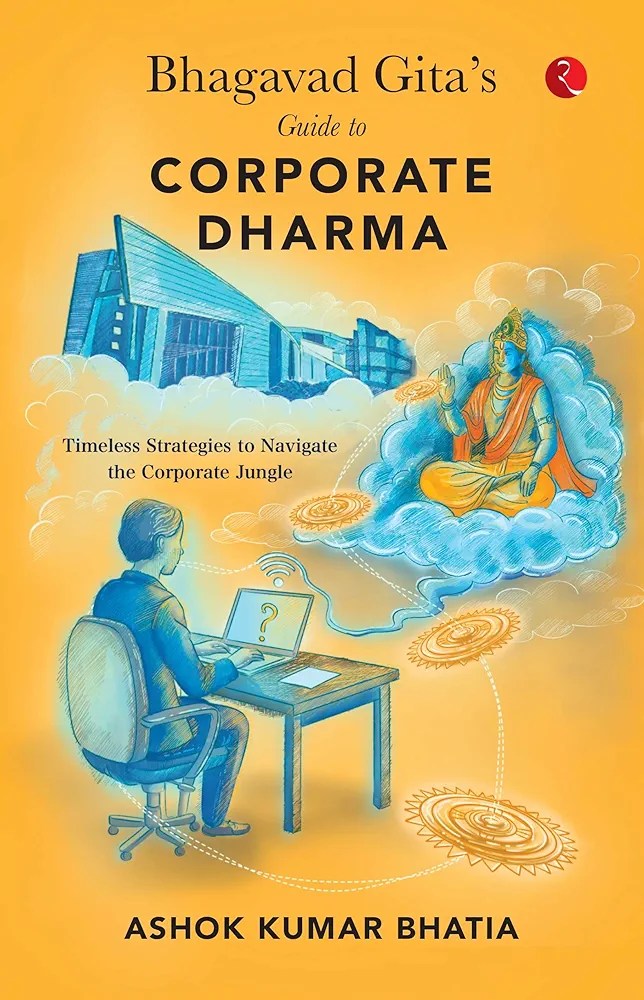
(This is an edited excerpt from my latest book, ‘Bhagavad Gita’s Guide to Corporate Dharma.’)
Hers is a balanced personality, free of unreasonable desires that could make her lose sight of her sense of righteousness. She does not have a binding attachment to her emotions. Nor does she have a jealous preference for her pet ideas or her pet people. She scoffs at nepotism. She encourages her team members to be nay-sayers, so voices of dissent can be heard and judiciously dealt with. She radiates positivity all around her. She is committed to the organisation’s goals and looks after her team members much like a lioness would protect her cubs.
Such a person of steady wisdom is described in the Bhagavad Gita as a Sthita-Prajna. Consider the following:
He whose mind is unperturbed amid sorrows; who among pleasures is free from longing; from whom attachment, fear and anger have departed; he is said to be a sage of steady intellect.
A People-centric Approach
Alfred Sloan is reported to have once remarked, ‘What is good for General Motors is good for America.’ J.R.D. Tata always thought the other way around. ‘What is good for India is good for Tatas.
Tatas keep following a people-centric approach to their business decisions. I believe that companies like Asian Paints, Eicher, Godrej, Hindustan Unilever, Infosys, Johnson & Johnson, Mahindra, and many others, also follow the same path. They shield their staff from major business upheavals, like the coronavirus which surfaced during 2020.
Led by enlightened leaders, such organisations surely earn brownie points in respect of enjoying employee goodwill.
(An edited excerpt from my latest book, ‘Bhagavad Gita’s Guide to Corporate Dharma’)
Whipping up a yummy omelette and putting it down the hatch is a pleasurable activity. But if the omelette has tiny pieces of eggshell in it, the whole experience turns negative. Each morsel turns to ashes in the mouth. The taste buds register a protest.
This is precisely what happens when a narrative, whether in the form of a write-up or a book, gets unleashed upon the unsuspecting public without proper editing.
The title and the subtitle of the manuscript may be short, crisp, and lucid. Both might give a clear idea to a potential reader of the contents. The subject may be good and set the book apart from others available in the market. The introductory chapter might be so attractive as to prompt the reader to go through all its chapters without any delay. The flow of logic might be smooth. The text may be divided into chapters which can be easily navigated. Sentences might be short and simple. The words might be simple and easy to comprehend.
But even minor irritants could put off many readers. Spelling disasters. Punctuation bloomers. An unpalatable mix of different versions of English. Inconsistent quotation presentation. Serpentine sentences that are hard to follow, and the like. They could not be blamed for putting the narrative aside and switching to a more delectable offering.
Having finished working on a manuscript, an author could then be found twiddling her thumbs trying to figure out ways of offering a product which is as defect-free as possible.
I confess I am not a professional editor. However, allow me to share a couple of lessons that I have picked up while looking at manuscripts from different authors, whether from India or elsewhere.
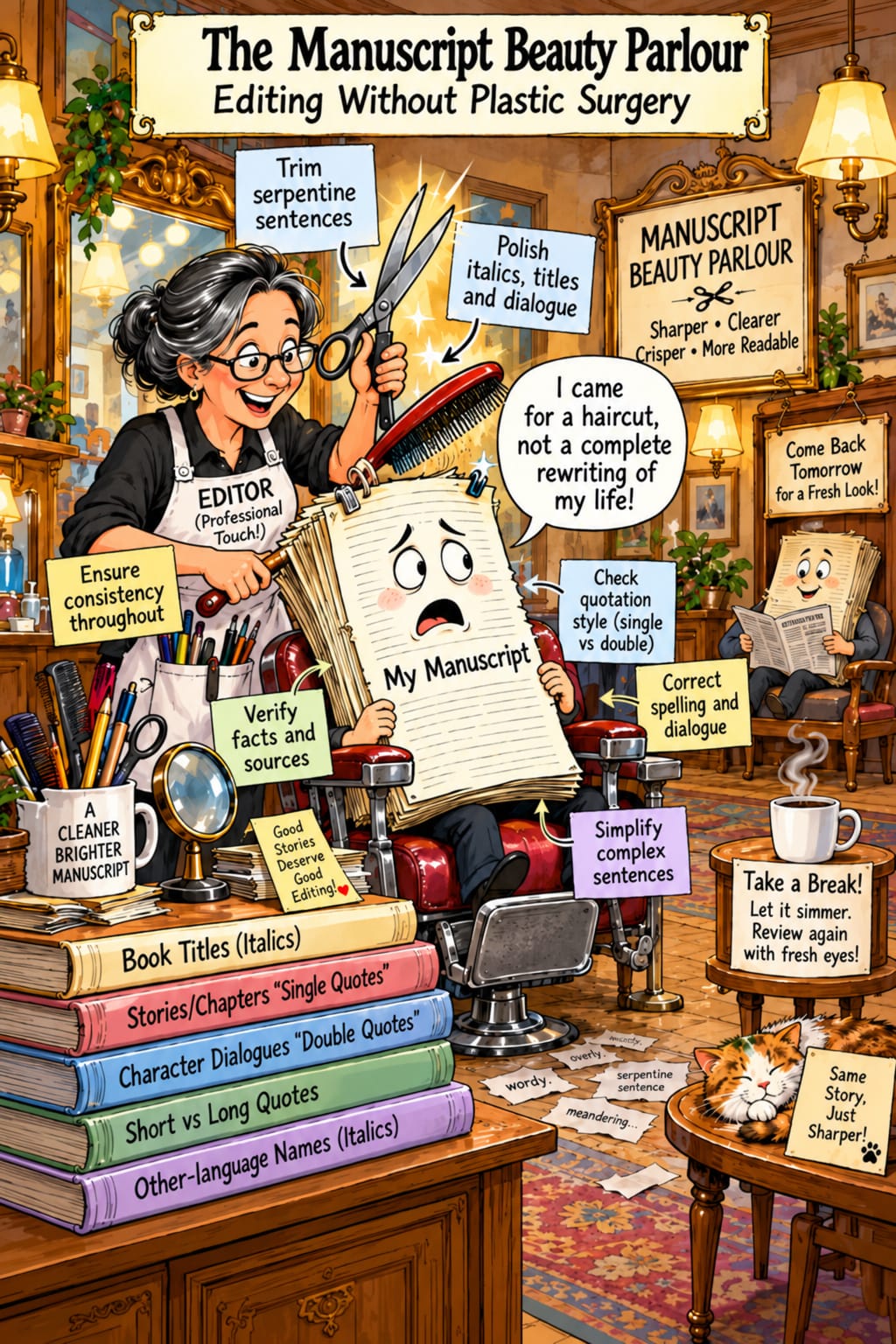
Names of books quoted in the text can be in italics.
Names of stories/journals/chapters quoted can be in plain text, highlighted with single inverted commas.
Dialogues of characters can be highlighted with double inverted commas.
Direct quotes can appear with either quote marks or in italics, not both. Quote marks are the norm, though. This practice can be consistent across the entire narrative.
Quotes of less than 140 words can be part of the running text, whereas the ones exceeding 140 words could be in a centre-aligned paragraph that follows, assuming the text is in a justified mode.
Lengthy quoted text can be set as display with a different font size.
Some names can be in italics for emphasis, especially if they originate from another language.
Having given finishing touches to the narrative, it helps not to be in a hurry to send it across for publication. Let it simmer within for some time. Take a break. Review it yet again after some time. You might discover a few more bloomers which had escaped your attention in the earlier round.
Editing is a delicate art. After all, a language is not like mathematics, where 1 + 5 will always equal 6! Depending on the context at hand, words have different connotations. Each author’s style of writing is different. When the manuscript gets revisited, new ideas might pop up. Expressing these ideas in a different way might sound more appealing to an author.
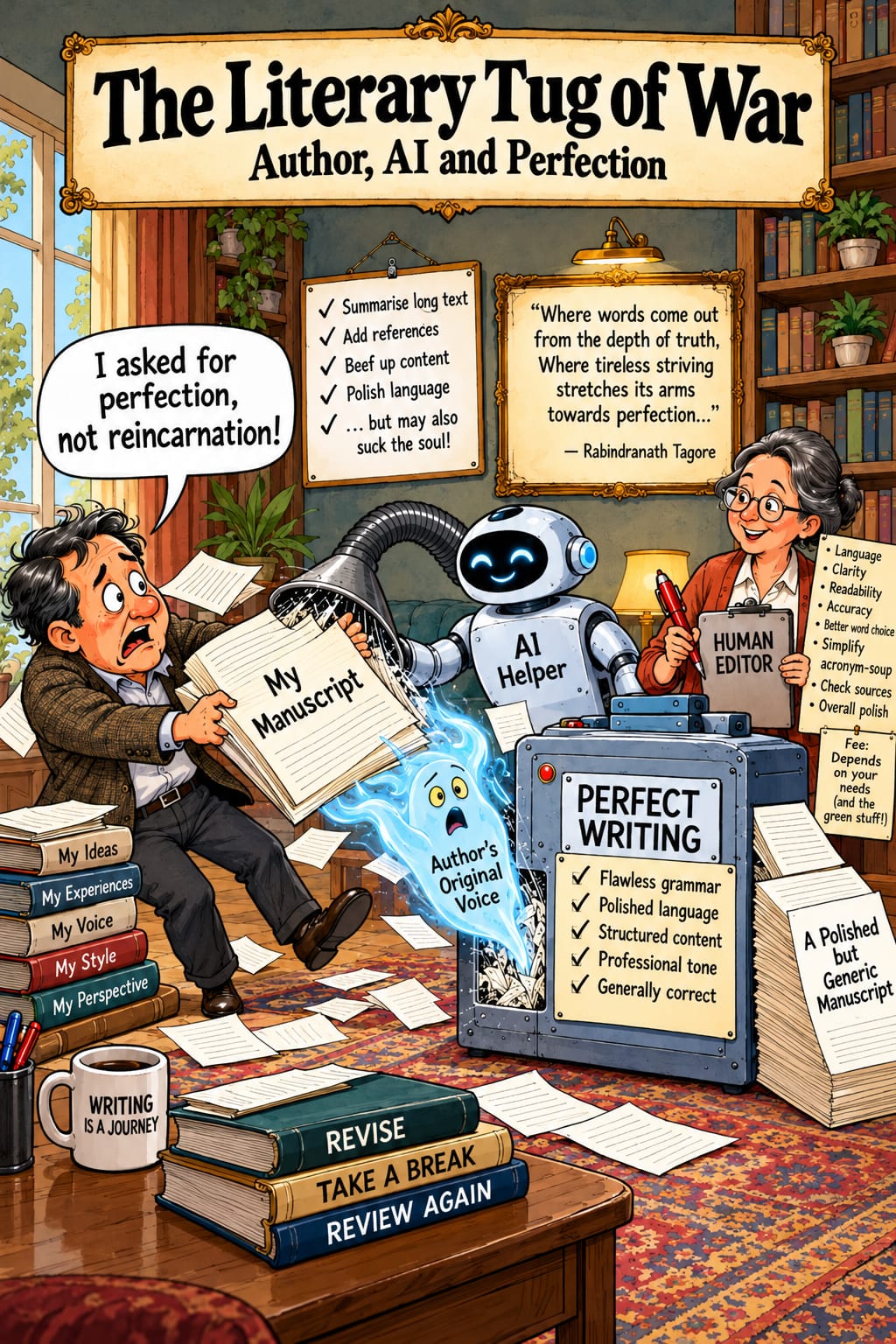
Of the online tools, Grammarly could be of some help. As far as AI is concerned it may be useful only if one needs a summary of, say, 2,000 words of a write-up which comprises 20,000 words. Or, if one needs to beef up the write-up with additional literary references. In any case, the risk of using AI is that it may end up sucking the soul of the narrative, thereby masking the author’s original voice itself.
There are quite a few professional editors available. Depending on the level of perfection you wish to achieve, and the green stuff you are willing to shell out, you may decide if you wish to approach one. Some editors may simply look at linguistic aspects. Others may go a bit deeper and suggest alternative words that could be used, recommend recasting complex sentences into shorter and crisper ones, check the veracity of sources quoted in the text, and even simplify the acronym-soup that some authors occasionally serve as an integral part of their text. A few could assist an author with developmental editing, suggesting improvements in the direction the narrative takes.
Editing is akin to a journey towards perfection, as described by Gurudev Rabindranath Tagore in his famous composition ‘Where the mind is without fear’:
…Where words come out from the depth of truth,
Where tireless striving stretches its arms towards perfection…
What fuels mighty achievements and the unique creations of artists like Vincent van Gogh or Michelangelo? Could they have produced their masterpieces if they were worried about market value or recognition? Newton, too, wasn’t distracted by past or future when the apple fell—otherwise, he might have missed discovering gravity. Similarly, a Silicon Valley innovator’s best ideas come from a focused, present-minded state conducive to creativity.
Beneath every inspired work lies the soul’s quest for bliss through doing something unique with effort and detachment. Living fully in the present moment helps one embrace an inspired life. Creativity flows like a form of meditation, where the creator, universe and surroundings align in harmony—a state of ‘Inspired Self-forgetfulness’ or ‘Detached Attachment’.
Achieving Excellence in Execution and Living a Free Life!
The Bhagavad Gita tells us that by practising the art of detachment, one learns to live in the present moment, neither fuming about what one did in the past nor anxious about what the morrow might bring. It is this skill which is alluded to as yoga.
The author paints a wide canvas of themes in this collection. The subjects are as different as chalk and cheese, with little repetition. Each story has a distinct and unique aroma which wafts through the consciousness of the reader.
What comes through clearly is the aurhor’s passion for expressing herself in words, an innate desire to bring into focus the social evils we suffer from, the keen eye that she has to capture the nuances of human behaviour, an in-depth understanding of relationships, and use of language that one can relate to. A lucid and enjoyable collection.
Whatever the trigger for each of the stories, all the narratives are based on detailed research done on the subject at hand, whether Covid-related medical investigations or the conditions inside a jail.
Let me share my reactions to different stories as follows.
Worthless
One pities the heroine for having lost her precious jewellery. The twist in the end is great, reminding one of stories by authors like Frederick Forsyth, O. Henry, and others. The story brings out a harsh truth of married life: that a communication gap between the two partners could lead to disasters.
Gone In A Wink
Oh, the social evil of the dowry custom! Reminded me of the recent OTT series ‘Dupahiya.’
The fact that both the kids were also in the sunken car besides their mother makes one feel even worse, though it serves as a good lesson for the hero.
The Switch
Frankly, I am amazed at the author’s virtuosity in whipping up this story. Hardened criminals, jail life, deadly brawls, switched identities, complicity of jail authorities – surely, these are not things one would normally experience in one’s life. Interesting.
Chained To A Virus
A reality check on the epidemic that all of us had to face a few years back. What stands out is the selfless support provided by the heroine to those in need. The end could break your heart.
Not Posthumously, Thank You!
A depressing story, this one. Suicidal thoughts arising out of loneliness. Draws our attention to the misuse of social media for personal gratification. But broadcasting live a murder, an illegal activity? The reader is left wondering if the hero did not worry about the imminent legal consequences. The present-day reality is eerily close to what the story depicts.
Twilight
The last two paragraphs beautifully capture the kind of loneliness that one feels within oneself occasionally. There are indeed times when one needs someone with whom one can share one’s innermost thoughts without any ego barriers.
This is what P. G. Wodehouse says:
“As we grow older and realise more clearly the limitations of human happiness, we come to see that the only real and abiding pleasure in life is to give pleasure to other people.” (Something Fresh)
What is missing here is a conclusion. You know that ‘The End’ feeling which you enjoy when you finish watching one of those ‘paisa vasool’ movies. Of course, there is a great deal of merit in leaving the end of the story open to a reader’s imagination.
All for Something
Here is the script of a thriller which could be gleefully lapped up by a director on any OTT platform. He/she could expand it to run for, say, 6/8 episodes, each of around 40 minutes in duration.
It conveys a message of great significance for society at large, pointing out the imminent danger of being tricked by persons whose real identities are hidden.
Bhairavi
Here is a story which describes graphically the process of an inner awakening. Bhairavi is the tantric Goddess that raises many deep spiritual questions to Bhairav or Shiva. I would say the theme falls on a boundary line of deep religiosity and spiritual faith bordering on hallucination and extraterrestrial experience. It depicts the decapitation of the head or ego by the author, who imagines she is Kali.
A Twisted Tale
This one is really twisted! The hero discovers that his abusive and argumentative wife has somehow done him something good!
I am not too sure about the percentage of people who happen to be bisexual in our society, but perhaps there are quite a few.
The Divine Hand
A love story during COVID times! A college-time romance which got rekindled, thanks to the epidemic and the lockdown.
Missing
What a tragedy. A story of star-crossed lovers. But a reader could be left wondering how the police missed the basement when they searched the house. And what happened to the baby Saroj was pregnant with?
At Any Cost
Strange to come across someone who does not want a domestic help even when she suffers from a few ailments and lives all alone. And the extent to which she goes to get rid of Basant! Quite a pot-boiler, this one. It appears that the heroine happens to be a perfectionist and wants someone who could follow her instructions without fail and do things exactly the way she herself would. A tall order, indeed.
Players
Those who love LGBTQ vibes would love this story, just like they would A Twisted Tale. What I liked was the detailed characterisation of the four players, and the way the author brings out their passion for whatever career they were pursuing.
The Family Curse
I had a feeling that perhaps the heroine would prove the curse wrong, but no luck!
This story could leave the reader depressed. Moreover, it could make them believe in the power of curses, nudging them towards superstition.
Lost Love
A story which is in the typical O. Henry mould. Goes on to show how much our perspectives get affected by deep-seated prejudices based on our past experiences. A Facebook post could get misinterpreted- and how! In any case, even if they had started a new phase of their relationship, she would have been burdened with his medical issues. Also, the fact that he was insistent on having her back, knowing fully well about his condition, goes on to show that he was essentially a selfish guy. A good commentary on the ego-centric ways of some members of the tribe of the so-called sterner sex.
About the Author
Dr Renu Singh Parmar is a former officer of the Indian Economic Service, with an MPhil in Humanistic Psychology and a PhD in Economics. She has written extensively on economic matters for publications such as The Economic Times, Deccan Herald, and The Hindu Business Line, and has contributed op-eds to The Times of India.
She is the author of four poetry collections—Ovarian Sentiments, Off the Radar, Whispers to Yogananda, and Inside Out—and this collection of short stories. Her poems have appeared in the Journal of the Poetry Society and Poetry India: Voices in the Making, an anthology published by the Poetry Society of India. Her short stories have been published in Story Cabinet and Kitaab.
A painter and storyteller, she brings to her writing a deep interest in human experiences, emotions, and the many dimensions of life.
On a lighter note, one needs to be wary of managements which exhort one to follow the much-misunderstood principle of detachment expounded in the Bhagavad Gita. They would have one believe that one should continue to slog all year long but would do well not to expect that elusive overdue promotion. One can then either grin and bear it or take prompt action through proper channels to get oneself detached from the company and move on to greener pastures elsewhere!
When Azim Premji decides to pledge his personal wealth for social causes, or when Tata Trusts start work on distributing iron-fortified salt in a state where women happen to be anaemic, the purpose for which businesses exist gets widened. When the hero of the movie Swades (2004, Director: Ashutosh Gowarikar) decides to chuck a promising career with NASA and return to serve his country, he is looking at the bigger picture selflessly.
This is how the Bhagavad Gita explains this state of mind:
Consider the case of Jet Airways, which shut its operations in April 2019 after having been a key player in the Indian airspace for over 25 years. The unwillingness on the part of the promoter family to let go of its control over the business made the airline eventually crash-land. Professionals were hired in top key positions, but the art of delegation was apparently given short shrift.
In family-owned businesses, the younger generation is often raring to go. Many a scion keeps wondering when the elder owner would hang his corporate boots or sandals, so they could have a free hand to nudge the enterprise towards newer markets, adopting the latest technologies sprouting in the era of the Industrial Revolution 4.0. But for most of the elderly owners, it is a tough challenge to give up control. Like the proverbial man who keeps clinging to a tree but blames the tree for not allowing him to let go, they refuse to fade away gracefully into the sunset. During the period of transition, chaos and confusion reign. Hapless employees continue to suffer silently, caught as they are between the divergent thought processes of the two generations.
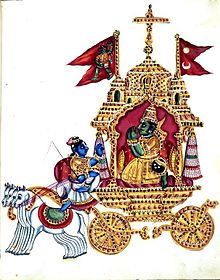
The war depicted in the epic Mahabharata, of which the Bhagavad Gita is an integral part, came about only because King Dhritarashtra could not overcome his attachment to either the throne or his son, Duryodhana. The outcome was the death of all his 100 sons, loss of prestige and kingdom, and of course, social and economic misery of the multitudes who had earlier thrived during his reign.
(The text is an edited excerpt from my latest book ‘Bhagavad Gita’s Guide to Corporate Dharma’.)
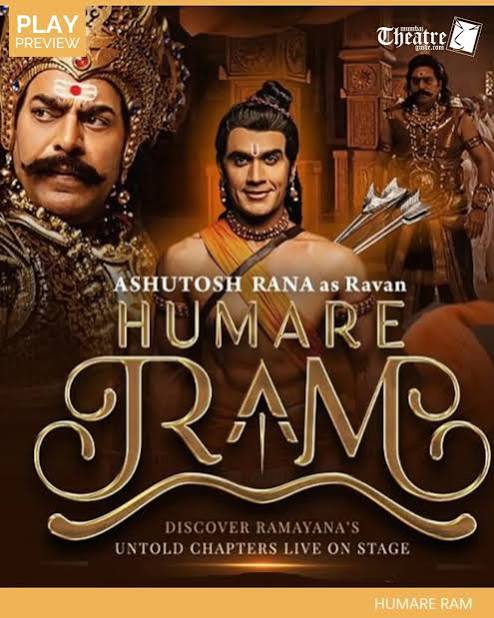
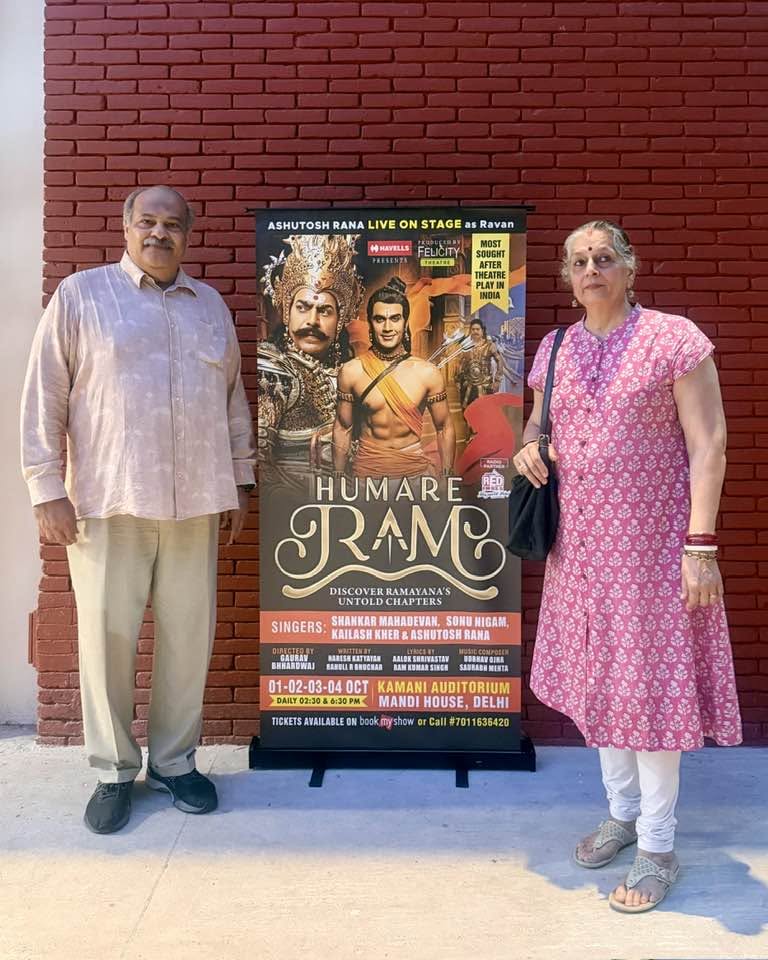
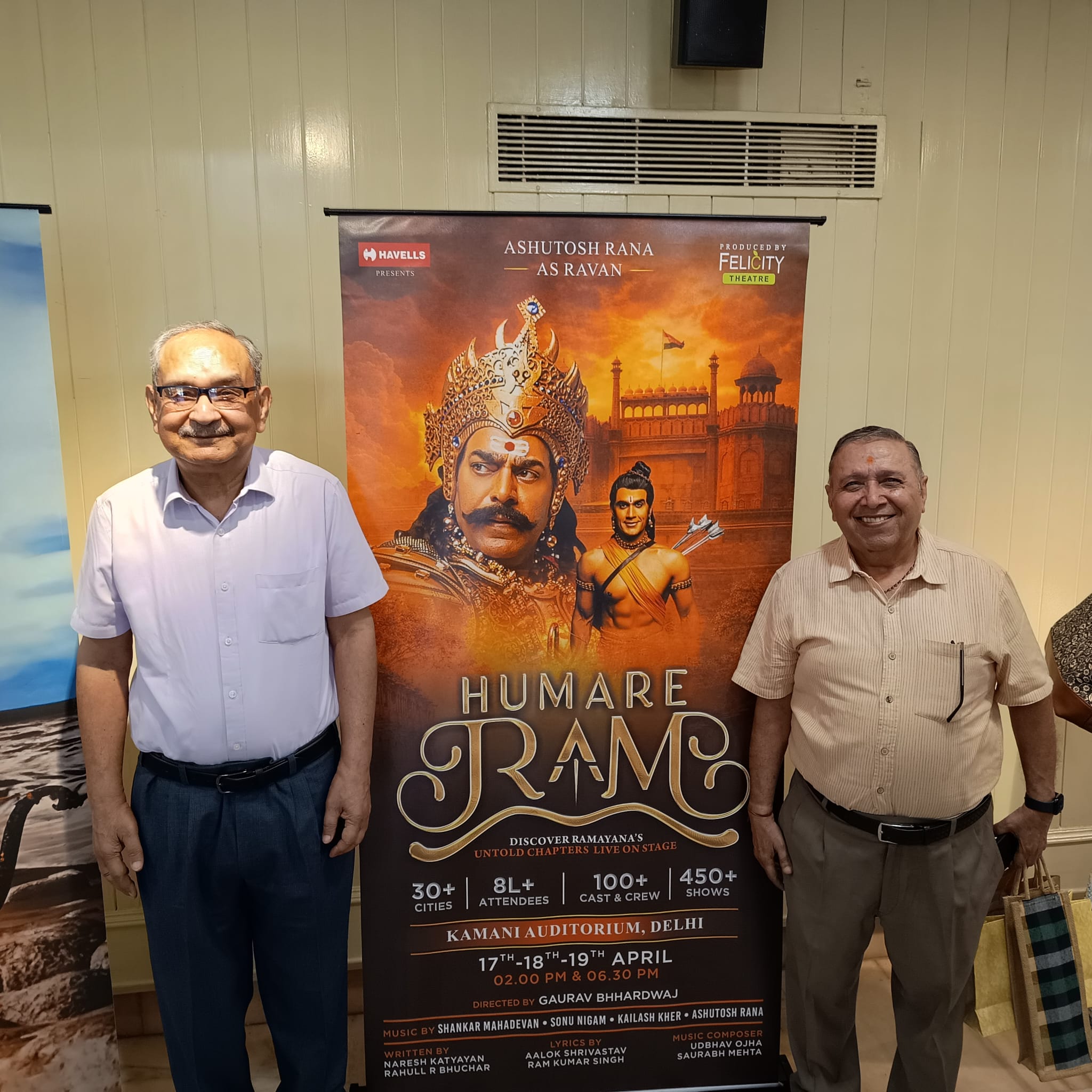
Humare Ram, by Felicity Theatre, featuring Rahul Bhuchar, my younger brother, as Ram and Ashutosh Rana as Ravana, is far more than a superb theatrical performance or a retelling of the Ramayana. Recently, it had yet another full house with likes of Manoj Muntasir and an elite Delhi audience at the Kamani auditorium.
It is an eye-opener to the extraordinary wisdom of our past — wisdom that remains remarkably relevant to our lives today.
From the very beginning, one is reminded of the sacred importance of a vachan — a word given, a promise made, a commitment that must be honoured, even when the price is immense.
And then comes the profound lesson of ahankar — the ego.
Perhaps the most moving moment comes when Lakshman, at the behest of Lord Ram, approaches Ravana to seek his blessings and wisdom. Ravana, despite being at the threshold of his end, possesses immense knowledge. When asked about the difference between himself and Ram, he gives an unforgettable answer:
“मुझे ज्ञान का अहंकार है और प्रभु राम को अहंकार का ज्ञान।”
(I have the arrogance of knowledge; Lord Ram has the knowledge of the ego.)
In that one sentence lies an entire philosophy of life.
The performance also brings alive the importance of respect for one’s parents, the sacredness of true love, the power of bhakti (devotion), and the realisation that knowledge alone is not enough.
Knowledge without humility can become arrogance.
Knowledge without devotion can remain incomplete.
And victory in life is not merely about possessing knowledge or power — it is about surrendering oneself to the Divine and allowing dharma (righteousness) to guide one’s actions.
That is what makes Humare Ram so exceptional.
The brilliance of the production lies not merely in the acting, the staging or the storytelling, but in its ability to make ancient wisdom speak directly to a contemporary audience. Rahul Butcher brings Ram to life with dignity and sensitivity, while Ashutosh Rana’s Ravana becomes a powerful embodiment of knowledge, brilliance, pride and the tragic consequences of unchecked ego.
The Ramayana and the Mahabharata are not merely ancient epics. They are two great civilizational streams that have travelled through generations, serving as a sutradhaar — a thread connecting our past, our present and, perhaps most importantly, our future.
Watching Humare Ram, I was reminded of Sri Aurobindo’s beautiful words:
“We belong not to the past dawns, but to the noons of the future.”
And perhaps that is the greatest lesson of all.
If our past was blessed with such extraordinary sages, such profound values and such timeless wisdom, then we should not merely look backwards with nostalgia.
We should ask ourselves: what magnificent future can we create by carrying those values forward?
May this extraordinary production reach every section of our society — our youth, educators, leaders, politicians, artists, families and citizens. May many more people have the opportunity to experience it, reflect upon it and carry its message into their own lives.
Having already crossed 573-odd performances in India as also elsewhere, I am sure Humare Ram will soon reach 1,000 shows — and deservedly so.
Because this is not simply a play about Ram.
It is a reminder of what it means to be human.
And perhaps, in a world increasingly driven by knowledge, power and ego, that reminder is needed more than ever.
Note
This article was first published on Facebook. Author’s consent to publish it here is gratefully acknowledged.
About the author
Lalit verma is the President of Aurodhan Art Galleries, Pondicherry, India.
A well-written book which provides invaluable insights for business learners like me to scale up by following existing cultural values.
When Dharma itself is becoming a rare phenomenon, infusing Dharma into the operations of a corporate entity is a novel idea. It reinforces that we should never forget our roots.
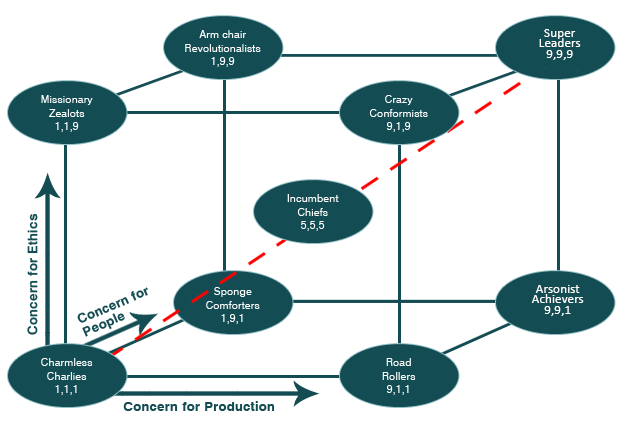
In the Bhagavad Gita, Lord Krishna exhorts us to rise above the three gunas and remain rooted in the self alone. He cites three kinds of personality traits, or gunas.
The Vedas’ concern is with the three gunas. Be without the three gunas, O Arjuna, without the pairs of opposites, ever established in purity, without possessions, possessed of the Self.
All of us have these three gunas in varying proportions— sattvic (benign goodness), rajasic (action-oriented) and tamasic (inaction, lethargy, procrastination). In different settings, even the proportions comprising a personality might be somewhat different. A devil in the office could be a loving father at home. Someone who champions the cause of women’s empowerment in public could be terrorising his wife at home.
The bouquets and brickbats hurled at one by life invariably represent opposites that one faces in life—success and failure, joys and sorrows, heat and cold, health and disease, and the like. A manager would typically face many a tough choice to be made in her career—that of chugging along in an assignment which pays well but is not close to her heart, or calling it quits, finding her true calling and pursuing her passion in life; an important meeting at the office versus annual day celebrations at her only child’s school at the same time; whether or not to show the door to a long-serving cashier who has recently been found having his hand in the till; and the like.
What Lord Krishna is suggesting here is for one to be trans gunas. This way, one attains a balanced and harmonious state in all of one’s activities, whether materialistic or spiritual, thereby leading to true happiness within, irrespective of whether one fails or succeeds in one’s efforts.
(The text is an edited excerpt from my latest book ‘Bhagavad Gita’s Guide to Corporate Dharma’.)